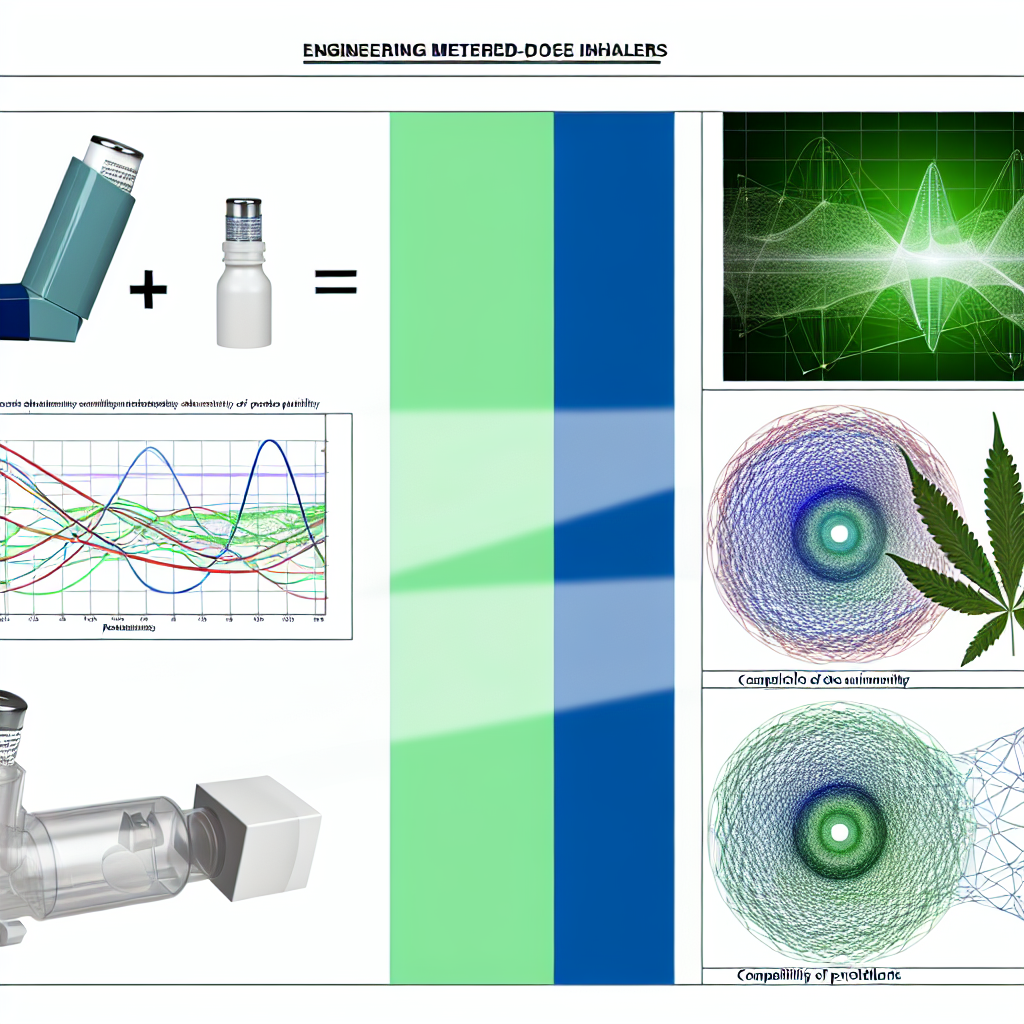
Engineering Metered-Dose Inhalers (MDIs) with Cannabis Extracts: Propellant Compatibility and Dose Uniformity
As the *cannabis industry* continues its rapid evolution, innovation in **delivery methods** remains at the forefront of **research and development**. Among the variety of *cannabis consumption* options, **metered-dose inhalers** (MDIs) are emerging as an exciting focus due to their potential for precise dosing and discreet use. Initially popularized within the **pharmaceutical industry** for conditions like asthma, MDIs offer a novel delivery method for cannabis extracts, allowing users to tailor their experience with precision akin to pharmaceutical standards.
The appeal of MDIs for **cannabis extracts** lies in their ability to offer controlled dosing, providing consumers and healthcare professionals with a method to achieve consistent and reliable effects. As the **therapeutic application of cannabis** grows, ensuring accurate dosage has never been more critical, particularly for those using cannabis for medical purposes. The close monitoring of dosages can significantly impact treatment plans, aiding in the provision of symptom relief while minimizing potential side effects. With the rise of **medical cannabis**, MDI technology ensures that even those with minimal experience can benefit from **controlled dosages**, receiving the correct therapeutic amounts needed for effective treatment.
Critical to the successful integration of cannabis extracts in MDIs is the selection of appropriate **propellants** and the assurance of **dose uniformity**. *Propellants* are the lifeblood of MDIs, responsible for delivering the extract in a fine mist. However, selecting a compatible propellant that does not degrade or alter the *cannabis compounds* represents a significant engineering challenge. Furthermore, ensuring dose uniformity—delivering the same amount of cannabis extract with each spray—remains crucial, as inconsistency could lead to under-dosing or overdosing, negating the benefits of using an MDI.
The complexity of formulating **cannabis MDIs** is compounded by the varying **pharmacological profiles** of cannabinoids such as **THC** and **CBD**, whose therapeutic effects are dosage-dependent. With **cannabis regulations** varying globally, standardization becomes an attractive yet challenging goal. Thus, continued research and development are vital to overcome these hurdles and ensure that cannabis MDIs fulfill their potential both for recreational and medicinal users.
Features: Advances in Propellant Technology and Dose Consistency
The challenge of integrating cannabis extracts into MDIs focuses heavily on the selection and compatibility of **propellants**. Traditional MDI formulations have utilized *chlorofluorocarbons* (CFCs) in the past. However, due to environmental concerns, newer propellants such as hydrofluoroalkanes (HFAs) have taken precedence. HFAs are hailed for their **eco-friendly profile**, but their suitability with cannabis extracts requires comprehensive study ([source](https://pubmed.ncbi.nlm.nih.gov/20356866/)).
A study highlighted in the **Journal of Aerosol Medicine** explored propellant-extract compatibility, focusing on maintaining the integrity and bioavailability of cannabis compounds following aerosolization ([source](https://www.liebertpub.com/doi/full/10.1089/jam.2020.1722)). This involves ensuring that **cannabinoids** do not chemically interact to degrade the product or reduce efficacy when dispersed through the propellant system. This is especially significant in **medical applications**, where the therapeutic outcome is closely tied to the accurate delivery of active compounds.
As **cannabis MDIs** move toward mainstream availability, another crucial factor is **dose uniformity**. Research conducted by **Bowen et al.** documented efforts to develop inhalers that could reliably deliver consistent volumes of aerosolized medication, emphasizing the importance of micro-dose precision ([source](https://journals.sagepub.com/doi/full/10.1177/1753465820931132)). This research aligns well with the development of cannabis formulations, as achieving consistent dosing is a primary objective in expanding the medicinal use of cannabis.
The need for precise dosing with cannabis MDIs is underscored when examining **cannabinoids’ pharmacokinetics**, which can significantly vary based on delivery method. Professionals working on these formulations aim to maintain the efficacy of traditional administration while enhancing control and predictability. This drive towards precision fosters trust in **cannabis-derived medications**, encouraging physicians to consider these formulations as viable options in patient care.
Conclusion
The development of **metered-dose inhalers** engineered with **cannabis extracts** heralds a new chapter in **cannabis consumption**, emphasizing precision and consistency. As **propellant compatibility** and **dose uniformity** continue to be refined, cannabis MDIs hold promise for both recreational users seeking convenience and **medical professionals** demanding accuracy. Continued research and technological advances will be crucial to surmounting current challenges, paving the way for these inhalers to integrate into mainstream use. Embracing this innovative delivery method, the **cannabis industry** is poised to deliver safer, more reliable experiences for consumers and patients alike.
**Concise Summary:**
The engineering of **metered-dose inhalers** (MDIs) with **cannabis extracts** presents an innovative frontier in **cannabis delivery**, emphasizing precision and discretion. Key challenges include selecting suitable **propellants** and ensuring dose uniformity to maintain *cannabinoid integrity* and achieve consistent dosing. As the therapeutic use of cannabis expands, these MDIs could provide precise dosing solutions, aligning with global regulatory standards and meeting both recreational and medicinal user needs. Ongoing research in propellant-extract compatibility and formulation consistency will be vital for integrating cannabis MDIs into mainstream use, offering reliable, eco-friendly, and effective dosage forms.