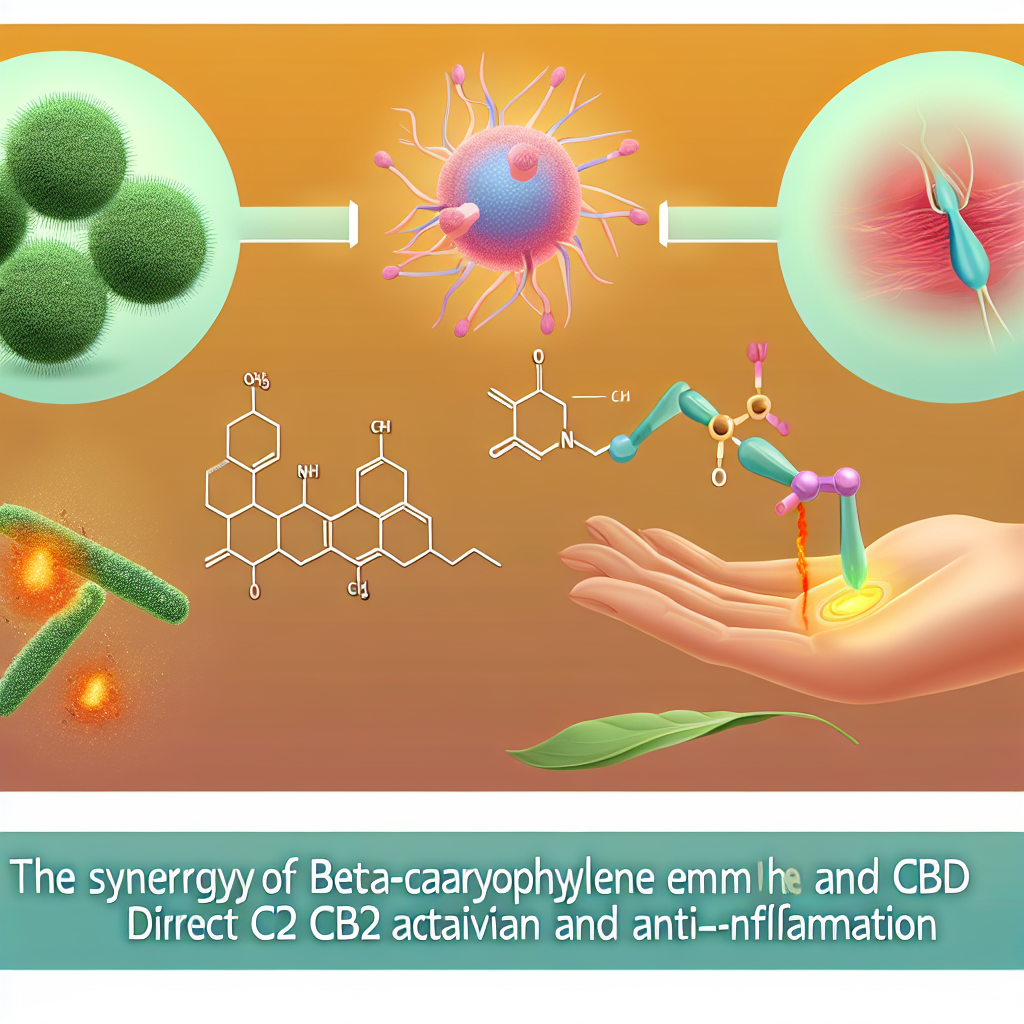
The Synergy of Beta-Caryophyllene and CBD – Direct CB2 Activation and Anti-Inflammation
Introduction
In the ever-evolving world of cannabis science, research continues to uncover the intricate and powerful interactions between plant compounds and human physiological processes. Among the most captivating of these discoveries is the synergistic interplay between beta-caryophyllene (BCP) and cannabidiol (CBD), particularly in their shared ability to activate the CB2 receptor in the endocannabinoid system (ECS).
Beta-caryophyllene is a unique terpene found abundantly in black pepper, cloves, hops, cinnamon, and many strains of cannabis. Unlike most terpenes, **BCP** is classified as a dietary cannabinoid because it can bind directly to **CB2 receptors**, which are primarily found throughout the immune and peripheral nervous systems. This capability allows BCP to exert **anti-inflammatory** and **analgesic** effects without psychoactivity or cognitive impairment, making it a standout component in cannabis therapeutics.
CBD, on the other hand, remains one of the most well-recognized non-intoxicating cannabinoids, known for supporting diverse physiological systems. Though it does not strongly bind to cannabinoid receptors, CBD influences the ECS indirectly through multiple pathways. These include inhibiting **FAAH** enzymes (which break down natural endocannabinoids like anandamide), altering receptor activity, and engaging with receptors such as **TRPV1**, **PPAR-γ**, and **5-HT1A**, contributing to CBD’s wide-ranging benefits in managing **pain**, **inflammation**, **anxiety**, and **neurological disorders**.
When combined, **CBD and BCP demonstrate a remarkable synergy**, enhancing each other’s effects—especially in reducing **inflammation** and regulating immune responses. This amplified outcome, often referred to as the **entourage effect**, suggests that thoughtful combinations of cannabis-derived compounds may offer more effective and holistic health interventions than isolated cannabinoids.
As scientific and anecdotal support grow, understanding the cooperative mechanisms of BCP and CBD is paramount for health professionals, product developers, and curious consumers. Their interaction holds the potential for more targeted treatments, supporting reductions in synthetic drug use and improving patient outcomes in conditions like **arthritis**, **autoimmune diseases**, and **neurodegenerative disorders**.
Scientific and Medical Features
Beta-caryophyllene holds a distinct position as the first recognized dietary cannabinoid capable of directly activating **CB2 receptors**. A landmark 2008 study by Gertsch et al., published in the journal PNAS, confirmed that BCP is a selective **CB2 agonist**, promoting **anti-inflammatory** and **analgesic effects** in mice models without engaging CB1 receptors, which cause psychoactivity. This drives interest in BCP’s use for immune and pain disorders without the high. [Read more](https://www.pnas.org/doi/full/10.1073/pnas.0803601105)
While **CBD** has limited direct affinity for CB2 receptors, it enhances **endocannabinoid tone** and receptor responsiveness through various routes. A 2018 review in Frontiers in Neurology uncovered that CBD inhibits **FAAH**, increasing endogenous anandamide levels, which interact positively with CB2 (and CB1) receptors. Additionally, CBD influences **neuroinflammation** and **oxidative stress** via action on **TRPV1**, **PPAR-γ**, and **serotonin receptors**, supporting its efficacy in conditions like **epilepsy, multiple sclerosis**, and **chronic pain**. [View study](https://www.frontiersin.org/articles/10.3389/fneur.2018.00759/full)
The synergistic relationship between CBD and BCP is receiving growing support in modern research. A 2020 preclinical study in Cannabis and Cannabinoid Research assessed the effectiveness of CBD-BCP formulations in **inflammatory arthritis** models. Administering both showed significantly stronger **inflammatory marker reduction** (TNF-α and IL-1β) compared to using either compound separately. This suggests that integrated formulations can enhance **therapeutic efficiency**. [Explore publication](https://www.liebertpub.com/doi/10.1089/can.2020.0021)
Because both CBD and BCP avoid CB1 interaction, they are ideal for those averse to psychoactive effects. This makes them particularly advantageous in **clinical scenarios** that demand mental clarity—such as **pediatric care**, general practice, or treatment of **mental health conditions**.
Recent studies are expanding these findings into neurodegenerative fields. A 2022 study conducted at the University of Naples explored co-therapy with CBD and BCP in animal models of **Alzheimer’s** and **Parkinson’s disease**. The results revealed reduced **amyloid plaque formation**, improved **cognitive behavior**, and dampened **brain inflammation**, making a case for their combined use in preserving **neurological health**. [Access research](https://www.ncbi.nlm.nih.gov/pmc/articles/PMC9136880/)
Outside of inflammation, both BCP and CBD have shown potential in managing **addiction**, **metabolic disorders**, and various **behavioral conditions**. For example, CBD’s influence on serotonin systems and BCP’s potential to curb addictive behaviors suggest the duo could support **mental health** and **weight management** protocols.
Custom formulations combining these compounds offer a versatile toolkit for natural health practitioners. Market-ready solutions may include **topicals**, **edibles**, **capsules**, and **sublingual oils**, allowing for **personalized remedies** based on a patient’s needs—whether acute, chronic, localized, or systemic.
Conclusion
The synergy between beta-caryophyllene and cannabidiol represents a transformative stride toward advanced plant-based therapies. By directly activating **CB2 receptors** and influencing ECS behavior, these two phytochemicals deliver potent **anti-inflammatory**, **analgesic**, and **neuroprotective effects**—without the psychoactive limitations of THC. As evidence continues to unfold, combinations of **CBD and BCP** may soon become foundational tools in personalized cannabis medicine and broader **natural wellness therapies**.
Concise Summary
Beta-caryophyllene (BCP) and cannabidiol (CBD) work synergistically to reduce inflammation by activating the CB2 receptor and modulating the endocannabinoid system. While CBD influences ECS activity indirectly and BCP directly stimulates CB2, their combined use enhances therapeutic outcomes without psychoactive effects. Clinical studies suggest benefits for autoimmune conditions, arthritis, and neurodegenerative diseases. With formulations now expanding to include topicals, oils, and edibles, this powerful duo is shaping the future of personalized and non-intoxicating cannabis-based therapies.
References
1. [Gertsch J. et al. (2008). Beta-caryophyllene is a dietary cannabinoid. PNAS](https://www.pnas.org/doi/full/10.1073/pnas.0803601105)
2. [Pellati F. et al. (2018). Cannabis sativa L. and Nonpsychoactive Cannabinoids. Frontiers in Neurology](https://www.frontiersin.org/articles/10.3389/fneur.2018.00759/full)
3. [Scandiffio L. et al. (2020). Terpenes and Cannabinoids Synergy in Inflammation. Cannabis and Cannabinoid Research](https://www.liebertpub.com/doi/10.1089/can.2020.0021)
4. [Di Giacomo V. et al. (2022). BCP and CBD Neurodegenerative Disease Study. Nutrients](https://www.ncbi.nlm.nih.gov/pmc/articles/PMC9136880/)