Far-Red Light Photomorphogenesis: Using Emerson Enhancement to Control Internodal Spacing and Flowering Speed
Introduction
With the evolution of cultivation techniques and lighting technologies, cannabis growers—whether commercial professionals or home hobbyists—are increasingly turning to the science of photomorphogenesis to fine-tune their outcomes. One exciting development at the intersection of horticultural science and cannabis cultivation is the strategic use of far-red light through the Emerson Enhancement Effect to manipulate plant structure and optimize the flowering process.
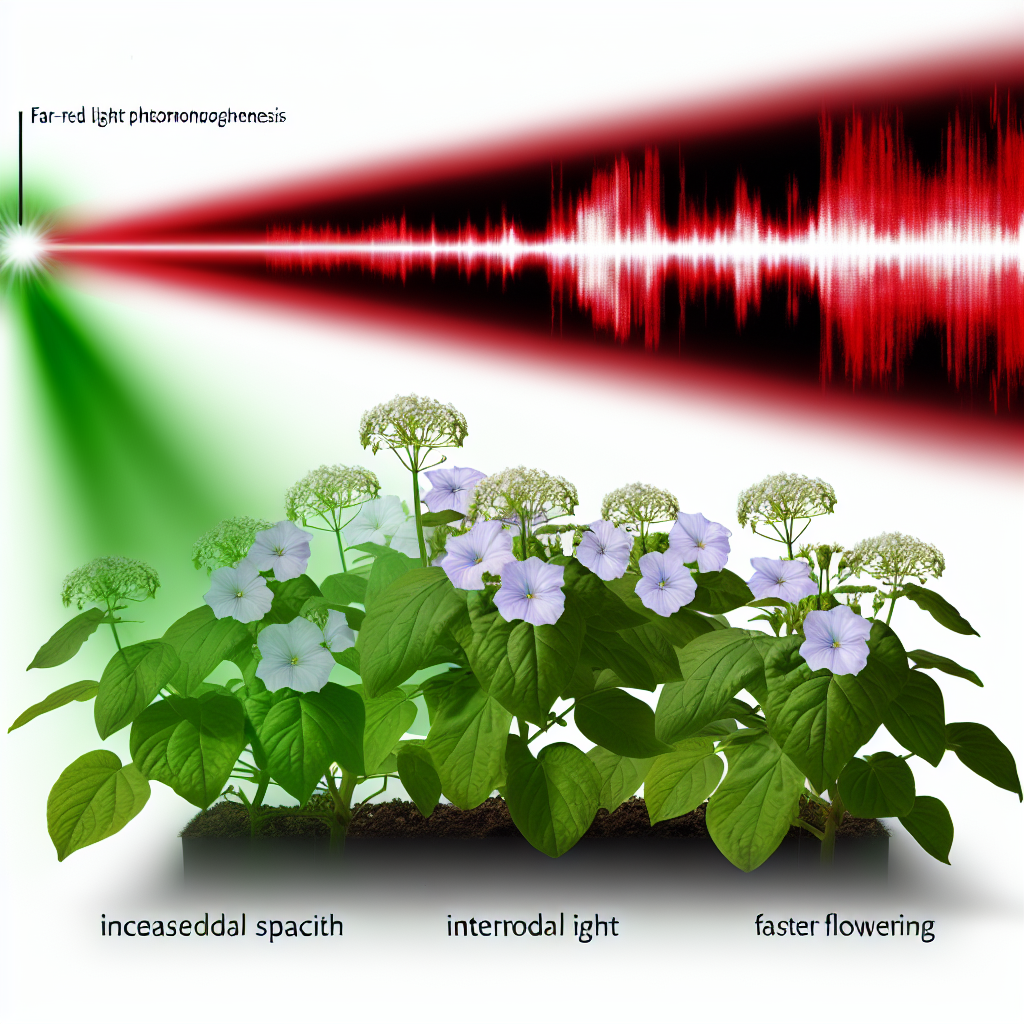
Photomorphogenesis refers to the way plants grow and develop in response to light wavelength cues. While red and blue light have long been staples in indoor cultivation, modern research highlights the underestimated role of far-red light—wavelengths typically ranging from 700 to 750 nanometers. When used in specific ratios with red light (600–700 nm), far-red light influences more than just plant stretching. It directly affects internodal spacing, plant height, flowering speed, and even yield potential—providing a highly controllable method for shaping outcomes.
The importance of far-red light in cannabis cultivation lies in its effects on the plant’s phytochrome system—a network of photoreceptors responsible for sensing and reacting to the spectrum of available light. Under elevated far-red exposure, plants “perceive” shading, triggering a response known as Shade Avoidance Syndrome (SAS). This stimulates vertical growth in efforts to reach unfiltered light. When combined with the increased photosynthetic efficiency from red/far-red synergy (as highlighted by the Emerson Effect), growers gain unprecedented control over plant architecture and development.
The Emerson Enhancement Effect, discovered by Robert Emerson in 1957, refers to the boost in photosynthetic efficiency when both red (around 680 nm) and far-red (around 700–710 nm) lights are used together. This synergy stimulates both Photosystem I and Photosystem II, significantly enhancing energy production and metabolic activity. These findings are especially transformable in the era of full-spectrum LED grow lights, where specific wavelengths can be dialed-in to maximize performance.
By incorporating tailored lighting strategies using this effect, cultivators can influence key characteristics including plant structure and time-to-flower—two factors critically important in rapid-cycle commercial grows where operational efficiency is essential.
This article explores both the scientific understanding and real-world applications of far-red light in cannabis cultivation, helping growers produce faster-flowering and structurally optimized plants.
Professional and Medical Studies Supporting Far-Red Light Applications
Numerous peer-reviewed studies have validated the powerful potential of far-red light in plant biology, offering insights that can be adapted for cannabis despite limited direct studies due to historic legal barriers. A combination of experiments on Arabidopsis thaliana and initial cannabis-specific trials now guide informed growing strategies.
A foundational finding in this space is the Emerson Enhancement Effect, unveiled in a 1957 study. Emerson found that when red and far-red light were combined, photosynthesis occurred at significantly higher levels than with either light alone. This is due to cooperative activation of both Photosystems I and II, leading to amplified energy generation—a critical component of plant growth and health.
In a more recent 2016 study published in Plant Physiology, researchers confirmed that far-red light enhances red light absorption, particularly under high-light settings such as those found in indoor grow facilities. Not only does this increase photosynthesis, but it also improves whole-plant efficiency—meaning better biomass and growth using the same energy input.
Further findings are documented in the 2019 journal article from Frontiers in Plant Science, which analyzed how low red to far-red ratios prompt faster flower induction in short-day plants like cannabis. By mimicking natural twilight conditions—where far-red is more prevalent—growers can effectively simulate seasonal transitions, encouraging plants to flower faster, even without modifying total light hours.
In a cannabinoid-specific context, Wageningen University (2021) conducted applied trials showing that cannabis plants grown with higher far-red content experienced substantial increases in bud weight and total height. Though excessive vertical stretch can be undesirable in compact grow spaces, managed properly, it improves light penetration to lower buds and facilitates better airflow—both of which improve bud quality and final yield.
Furthermore, timing exposure is critical. Implementing far-red light during the final 15–30 minutes of the light cycle—the so-called end-of-day treatment—can reset phytochrome signals and shift the plant’s internal clock towards flower induction. By manipulating the photoperiod at a molecular level, growers gain the ability to initiate flowering under conditions that would traditionally still be considered vegetative—without changing the 12/12 schedule. This flexible control offers novel approaches to cycling and scaling operations, vital for operations seeking faster turnaround.
Conclusion
By leveraging the Emerson Enhancement Effect, growers now have a science-backed tool to optimize plant form and boost profitability. Using targeted far-red lighting strategies allows for measurable improvements in structure, flowering timelines, and final harvest metrics. In an increasingly competitive market, where every efficiency counts, mastering far-red photobiology could offer a decisive edge.
Emerging technologies in LED lighting now make spectrum customization easy and affordable, enabling both small-scale and industrial growers to execute these techniques effectively. As the legal cannabis space matures, integrating the latest in plant physiology with advanced lighting control is a strategic move that supports yield enhancement and operational agility.
References
- Emerson, R. (1957). Dependence of Yield of Photosynthesis in Long-Wave Red on Wavelength and Intensity of Supplementary Light. Proceedings of the National Academy of Sciences.
- Kalaitzoglou, P. et al. (2019). The role of far-red light in plant morphology and flowering physiology. Frontiers in Plant Science.
- Zhen, S., van Iersel, M.W. (2016). Far-red light is needed for efficient photochemistry and photosynthesis. Plant Physiology.
- Wageningen University & Research (2021). Horticultural lighting: Cannabis crop performance under various light spectra.
Concise Summary
The strategic use of far-red light in cannabis cultivation allows growers to optimize plant structure and hasten flowering. Leveraging the Emerson Enhancement Effect, red and far-red light combinations increase photosynthetic efficiency and trigger growth responses through the phytochrome system. End-of-day far-red treatments can manipulate perceived photoperiods, accelerating flower induction without changing light schedules. Supported by scientific studies, this approach offers benefits such as improved yield, controlled internodal spacing, and faster turnaround—making far-red integration a crucial technique in modern indoor growing.