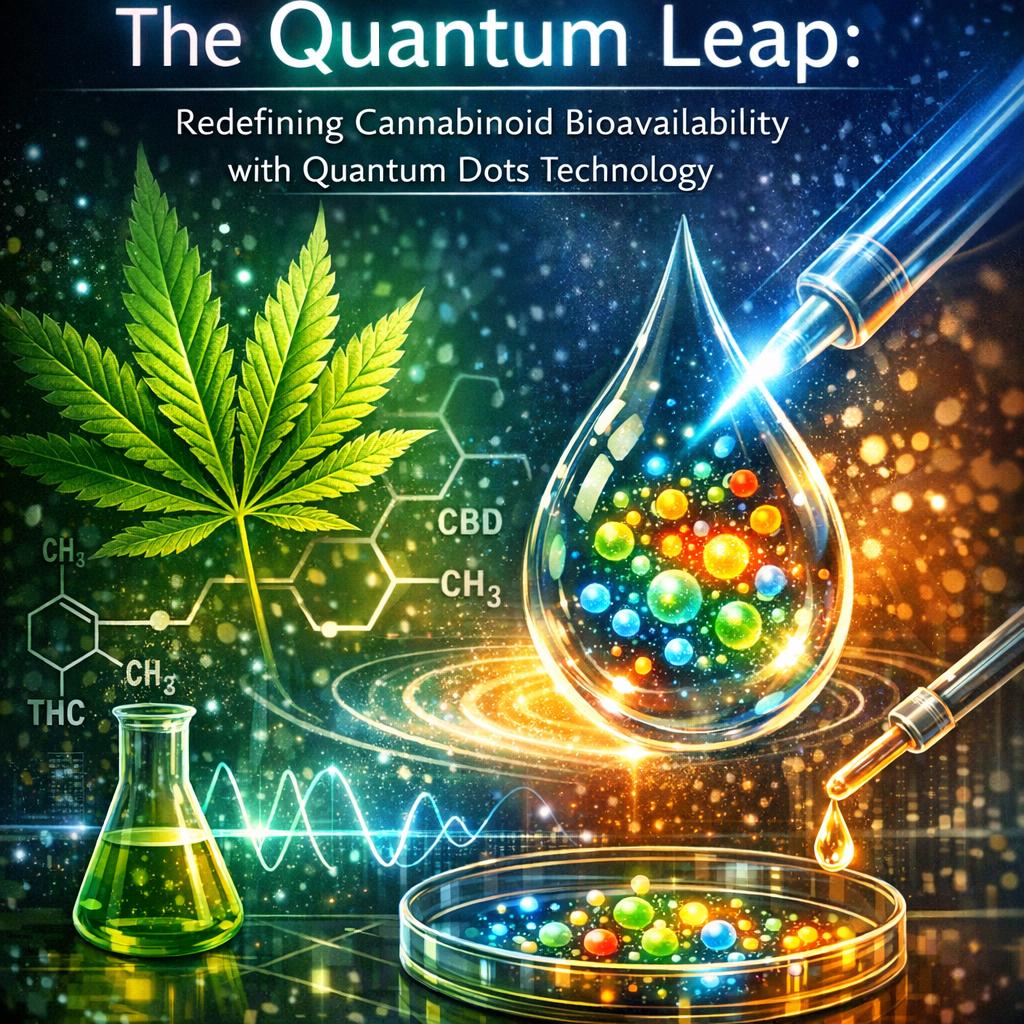
The Quantum Leap Redefining Cannabinoid Bioavailability with Quantum Dots Technology
Introduction
In recent years, the cannabis industry has been at the forefront of scientific innovation, continually exploring ways to optimize the therapeutic potential of cannabinoids. A key challenge in maximizing this potential is bioavailability, which refers to the degree and rate at which an administered drug is absorbed by the body’s circulatory system, thereby becoming accessible to the intended site of action. In the realm of cannabinoids, enhancing bioavailability is crucial for effective therapeutic outcomes, especially given the limited absorption of orally consumed cannabinoids like CBD and THC.
Traditionally, cannabinoids exhibit low bioavailability due to their hydrophobic nature and the body’s natural filtration systems. Oral ingestion often results in a small fraction reaching the bloodstream, largely due to first-pass metabolism in the liver. This inefficiency necessitates the development of novel delivery systems to overcome bioavailability barriers.
Enter quantum dots technology, a cutting-edge advancement poised to revolutionize cannabinoid delivery. Quantum dots are nanoscale semiconductor particles with unique optical and electronic properties. When integrated into drug delivery systems, their nanoscopic size and surface versatility enable enhanced penetration and controlled release of drugs, including cannabinoids.
Quantum dots have already demonstrated success in various medical fields, such as imaging and targeted drug delivery, due to their capability to navigate complex biological environments effectively. In cannabinoid delivery, they leverage their ultra-small size to enhance solubility, potentially increasing uptake through mucous membranes and tissues, resulting in more efficient therapeutic effects.
Features
In recent years, the exploration of quantum dots in enhancing drug bioavailability has gained substantial attention within the scientific community. Several studies underscore the promising intersection of quantum dot technology and cannabinoid delivery.
Notably, research published in the [*Journal of Nanobiotechnology*](https://jnanobiotechnology.biomedcentral.com/) highlights quantum dots’ ability to improve the solubility of hydrophobic compounds, such as cannabinoids, by creating a nanoscale delivery system that bypasses traditional barriers. Such findings suggest this technology could optimize cannabinoid delivery, which often suffers from poor water solubility.
In a notable exploration by researchers in nanomedicine, quantum dots loaded with cannabinoids were observed to provide controlled and sustained release profiles. The encapsulated cannabinoids displayed enhanced absorption rates and maintained structural integrity, ensuring the therapeutic compounds remained potent throughout the process. These advancements position quantum dots as a superior delivery vehicle, particularly for cannabinoids.
Furthermore, the unique surface characteristics of quantum dots allow for functionalization with targeting ligands, enabling precise delivery to specific tissues or cells. This targeted delivery system has significant implications for medical cannabis applications, where precise dosage and localization are crucial for treatment efficacy, particularly in conditions like chronic pain, epilepsy, and cancer.
While the clinical application of quantum dots in cannabinoid delivery is still in its early stages, these preliminary findings offer a promising horizon for future developments. As researchers continue to unravel the potential of quantum dots, they hold the promise of transforming cannabinoid therapeutics, making them more effective and accessible.
Conclusion
The integration of quantum dots technology within the cannabis industry represents a leap forward in overcoming bioavailability challenges. As more research is conducted and new applications explored, the marriage of quantum dots and cannabinoids could revolutionize the way we perceive and utilize medical cannabis. Through increased bioavailability and targeted delivery, patients could experience more consistent, reliable therapeutic effects, propelling the cannabis industry into a new era of scientific excellence.
References
1. [Journal of Nanobiotechnology](https://jnanobiotechnology.biomedcentral.com/)
2. [Nanomedicine Research](https://www.futuremedicine.com/loi/nnm)
Concise Summary: Quantum dots technology is poised to transform cannabinoid delivery by overcoming bioavailability challenges associated with cannabinoids like CBD and THC, which are typically hydrophobic. Quantum dots enhance solubility and enable controlled, targeted delivery, potentially revolutionizing medical cannabis applications in conditions like chronic pain, epilepsy, and cancer. As research advances, this innovative approach could reshape cannabinoid therapeutics, offering more effective and reliable outcomes for patients.