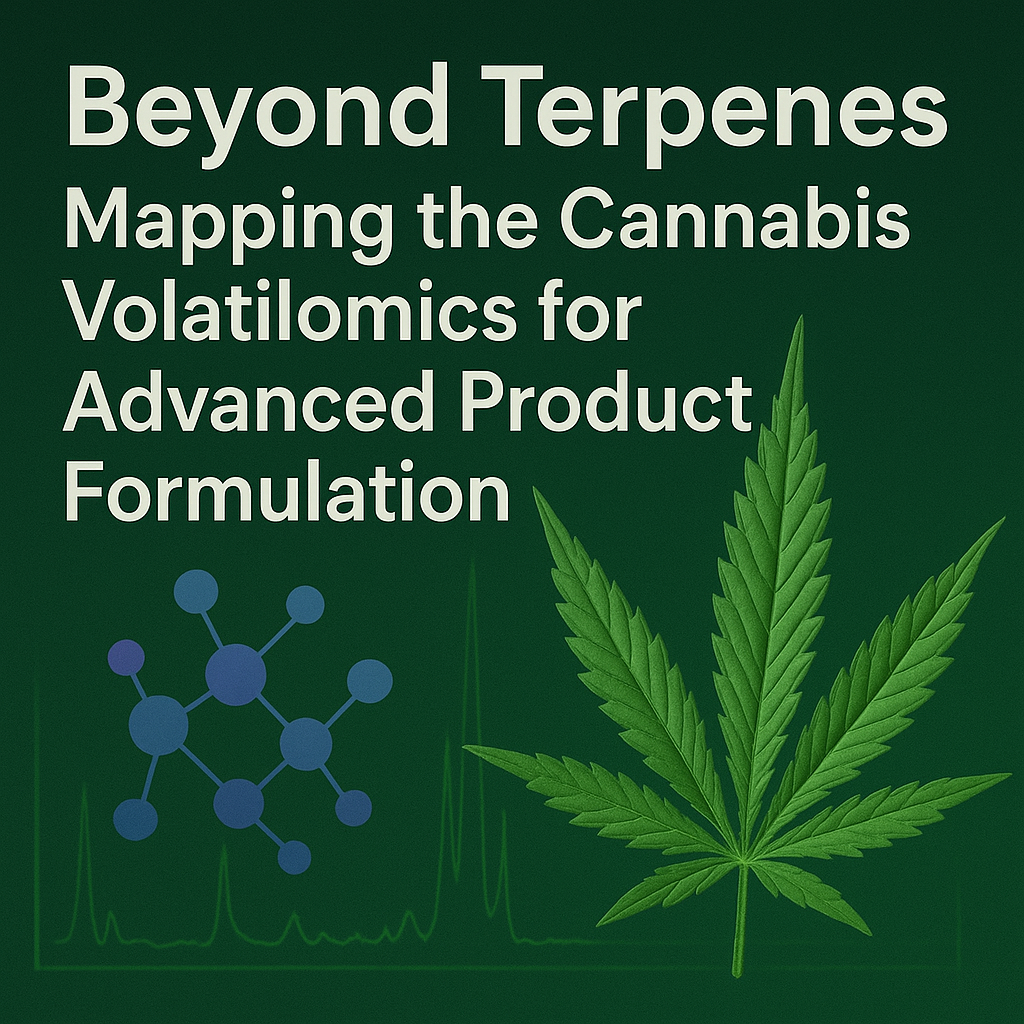
Beyond Terpenes: Mapping the Cannabis Volatilomics for Advanced Product Formulation
Introduction
As the cannabis industry matures and expands, the demand for advanced product formulations is at an all-time high. While much of the industry’s focus has been on cannabinoids like THC and CBD, there’s a deeper, more nuanced layer to explore: the volatile compounds responsible for cannabis’s unique aroma and flavor profiles. These compounds, known collectively as the cannabis volatilome, include terpenes, esters, alcohols, ketones, and others. Historically, terpenes have stolen the spotlight, celebrated for their contribution not only to the sensory experience of cannabis but also to its therapeutic effects. However, by expanding our gaze beyond terpenes and investigating the intricate web of volatile compounds, we can unlock new potentials for both consumers and professionals in the cannabis industry.
Understanding the cannabis volatilome can lead to more precise product formulation, addressing specific consumer needs, and enhancing therapeutic outcomes. Volatilomics, the comprehensive study of volatile compounds in an organism, provides deeper insights into not just single compounds but the synergistic interactions between them. This approach recognizes that the effects of cannabis are not solely due to its major cannabinoids or isolated terpenes but result from the complex interplay of its entire chemical profile, often referred to as the “entourage effect.”
Emerging research indicates that non-terpene volatiles can significantly influence the physiological and psychological effects of cannabis. These compounds may modulate the therapeutic properties of cannabinoids, broaden the range of effects achievable by cannabis, and fine-tune the consumer experience. As such, they present an untapped frontier for innovation, where subtle adjustments in the volatilomic profile of a cannabis product could lead to more targeted personal user experiences and an expansion in the variety of therapeutic applications.
The exploration of cannabis’s volatilomics paves the way for a future where product formulation is science-driven and geared toward maximizing both efficacy and enjoyment. By adopting a volatilomic approach, cannabis professionals can cultivate a more thorough understanding of their botanical material and enact innovative strategies to create unparalleled new products.
Features
Recent advances in analytical techniques have enabled deeper insights into the cannabis volatilome, influencing both product formulation and consumer use. Studies leveraging methods like Gas Chromatography-Mass Spectrometry (GC-MS) have revealed that beyond the commonly discussed terpenes, a vast array of volatile organic compounds (VOCs) contributes to a strain’s profile.
[Research](https://www.frontiersin.org/articles/10.3389/fpls.2019.00835/full) demonstrates that esters, for example, often found in fruits and flowers, play a role in determining the aroma profile of cannabis. Esters can interact synergistically with terpenes, potentially enhancing or modifying their effects. Such findings suggest that formulators could manipulate ester contents to accentuate certain desired experiences or mask less desired ones.
Moreover, a study published in the [Journal of Natural Products](https://pubs.acs.org/doi/10.1021/acs.jnatprod.8b00876) identifies ketones and aldehydes as influential compounds affecting aroma and taste. These volatiles may also contribute to the entourage effect, subtly influencing therapeutic outcomes. Understanding and manipulating the presence of these compounds can allow for more targeted effects, potentially aiding in the treatment of conditions like anxiety, depression, and pain management depending on their combinations with cannabinoids and terpenes.
In parallel, professional [cultivation techniques](https://www.ncbi.nlm.nih.gov/pmc/articles/PMC6300652/) are evolving, aiming to optimize environmental conditions to selectively enhance desired volatilomes profiles. For example, stress training and controlled growth environments are being employed to manipulate the plant’s metabolic pathways, with the aim of achieving specific volatilomic profiles that synergize with the cannabinoids for targeted consumer experiences.
Educational initiatives are also underway, striving to elevate the understanding of cannabis chemistry among industry professionals. Workshops, webinars, and certification programs are being designed to teach the principles of volatilomics, preparing a new generation of cannabis experts. This formal knowledge sharing supports high standards of product innovation and ensures consumers are receiving the most refined cannabis experiences possible.
Conclusion
The exploration of the cannabis volatilome represents a forward-looking approach to product formulation, offering a nuanced path to enhancing both medicinal benefits and consumer enjoyment. By moving beyond terpenes, we embrace an untapped realm rich with potential, promising more precise, tailored, and effective cannabis products. As this burgeoning field continues to grow, it challenges us all to deepen our understanding and appreciation for the full spectrum of compounds contributing to cannabis’s unique qualities.
References
1. [Frontiers in Plant Science – Comprehensive Metabolite Profiling of Cannabis](https://www.frontiersin.org/articles/10.3389/fpls.2019.00835/full)
2. [Journal of Natural Products – Identification of Bioactive Compounds in Cannabis](https://pubs.acs.org/doi/10.1021/acs.jnatprod.8b00876)
3. [National Center for Biotechnology Information – Analytical Techniques for Cannabis Volatiles](https://www.ncbi.nlm.nih.gov/pmc/articles/PMC6300652/)
Concise Summary
The exploration of the cannabis volatilome highlights a comprehensive study beyond terpenes, focusing on volatile organic compounds (VOCs) like esters, ketones, and aldehydes contributing to cannabis’s aroma, flavor, and therapeutic properties. Recent advances in techniques such as GC-MS enable precise product formulations catering to consumer preferences. This approach, aligned with evolving cultivation methods and educational initiatives, offers significant potential for tailored therapeutic applications. By understanding these synergies, the industry promises refined, effective, and enjoyable cannabis products, moving the focus toward holistic chemical profiling rather than isolated compounds.