The Quantum Leap: How Quantum Dots Could Revolutionize Light Spectrum Control in Cannabis Cultivation
Introduction
The cannabis industry is witnessing unprecedented growth, driven by increasing legalization and a booming market for both medicinal and recreational use. As cultivation practices advance, cultivators are constantly seeking innovative techniques to enhance plant yields, potency, and efficiency. One groundbreaking technology poised to make a significant impact is quantum dots. These nanoscale semiconductor particles have the potential to revolutionize how we control the light spectrum in cannabis cultivation, ushering in a new era of efficiency and precision in indoor farming.
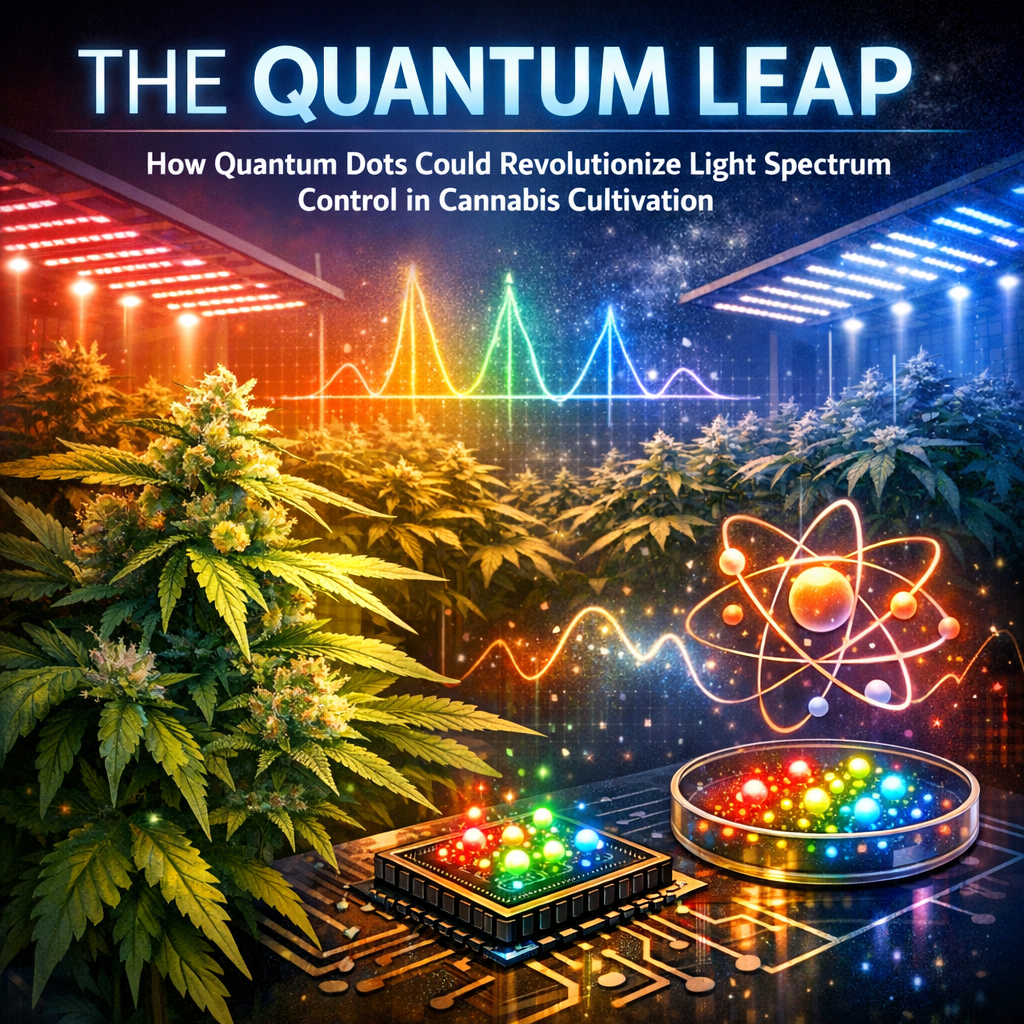
Cannabis plants, like other photosynthetic organisms, rely on light for growth. The light spectrum specifically influences plant development pathways, affecting everything from stem elongation to flowering times. Traditional cultivation setups often use broad-spectrum lights which are not finely tuned to maximize plant efficiency. This is where quantum dots come into play. These nanoparticles emit specific wavelengths of light when exposed to UV radiation or electric fields. The emission can be finely tuned based on the size and material of the quantum dot, enabling precise control over the spectrum.
The application of quantum dots in cannabis cultivation promises several advantages. By tailoring the light spectrum to the optimal wavelengths for cannabis growth—such as those predominantly absorbed by chlorophyll a and b—a more efficient photosynthetic process can be achieved. This could lead to increased biomass and cannabinoid production, offering cultivators better yields and higher quality harvests. Furthermore, the energy efficiency of quantum dots could substantially reduce the carbon footprint of cannabis cultivation by minimizing energy consumption.
The implications of this technology extend beyond improved growth. For cultivators, quantum dots offer consistency in growth cycles, translating to predictable harvest times and uniform product quality. Additionally, this technology could allow for the fine-tuning of specific plant characteristics, paving the way for more targeted development of cannabis strains with desired cannabinoid and terpene profiles—an enticing prospect for both recreational and medicinal users.
Features
Recent studies and ongoing research have begun to shed light on the potential impact of quantum dots in agricultural settings. A key study published in the journal Advanced Materials explored the use of quantum dots in regulating the light spectrum for enhanced photosynthetic activity. The research showcased the ability of quantum dots to selectively filter and convert light into photosynthetically active radiation (PAR), significantly optimizing plant growth efficiency. [source](https://onlinelibrary.wiley.com/doi/10.1002/adma.201904675).
In the context of cannabis, the tailoring of light wavelengths can influence various growth factors, including stem elongation, leaf development, and flower budding. The customized light environment created by quantum dots can support specific phases of the plant’s life cycle more effectively than traditional grow lights. This precise control is particularly beneficial in vertical farming setups where space is at a premium and light uniformity is crucial.
Moreover, quantum dot technology aligns with sustainability efforts in agriculture. A study in the Journal of Nanobiotechnology elaborated on the energy-saving potential of quantum dots, reporting a significant reduction in energy needs compared to conventional LED systems [source](https://jnanobiotechnology.biomedcentral.com/articles/10.1186/s12951-019-0490-8). The emission efficiency of quantum dots means less heat output, reducing the need for extensive cooling systems and thereby conserving energy.
Medical implications are no less significant. By optimizing growing environments, cultivators can produce cannabis with specific profiles desirable for certain medical applications, like high-CBD strains for epilepsy or high-THC varieties for chronic pain management. The ability to consistently produce these targeted profiles aligns with ongoing clinical research efforts seeking to better understand and utilize the medicinal properties of cannabinoids.
Conclusion
Quantum dot technology represents a significant technological advancement in the realm of cannabis cultivation, offering an unprecedented level of control over light spectrums. By enhancing growth efficiency and sustainability, these nanoparticles promise not only to revolutionize how we grow cannabis but also to pave the way for advancements in the quality and consistency of cannabis products. As research and development continue, quantum dots could very well become a staple in modern cultivation methodologies, leading the industry into a brighter, more efficient future.
Concise Summary:
Quantum dot technology is set to revolutionize cannabis cultivation by enabling precise light spectrum control, enhancing photosynthetic efficiency, and offering significant energy savings. These nanoparticles emit specific wavelengths, promoting desired growth traits and strain-specific profiles, vital for both medicinal and recreational use. Studies demonstrate their potential in optimizing growth cycles and achieving uniform product quality, aligning with sustainability goals by reducing the energy footprint. As research progresses, quantum dots could become integral to modern cultivation practices, transforming the quality and consistency of cannabis products.