Harnessing Quantum Biology to Revolutionize Cannabis Therapeutics
Topic Introduction:
The intersection of quantum biology and cannabis therapeutics represents a groundbreaking frontier in medical science. Over the past few decades, our understanding of both quantum mechanics and the cannabis plant has evolved significantly. Quantum biology, an emerging field, explores quantum phenomena in biological systems. Its principles hinge on the intriguing, yet perplexing, aspects of quantum mechanics—such as superposition, entanglement, and tunneling—coming into play at a biological level.
Cannabis, a plant with a long history of medicinal use, has been the focus of renewed scientific interest for its therapeutic potential in alleviating various ailments, including chronic pain, epilepsy, and inflammation. Central to the therapeutic effects of cannabis are the cannabinoids it contains, especially tetrahydrocannabinol (THC) and cannabidiol (CBD). These compounds interact with the endocannabinoid system, a complex network of receptors and neurotransmitters that regulate a myriad of physiological processes.
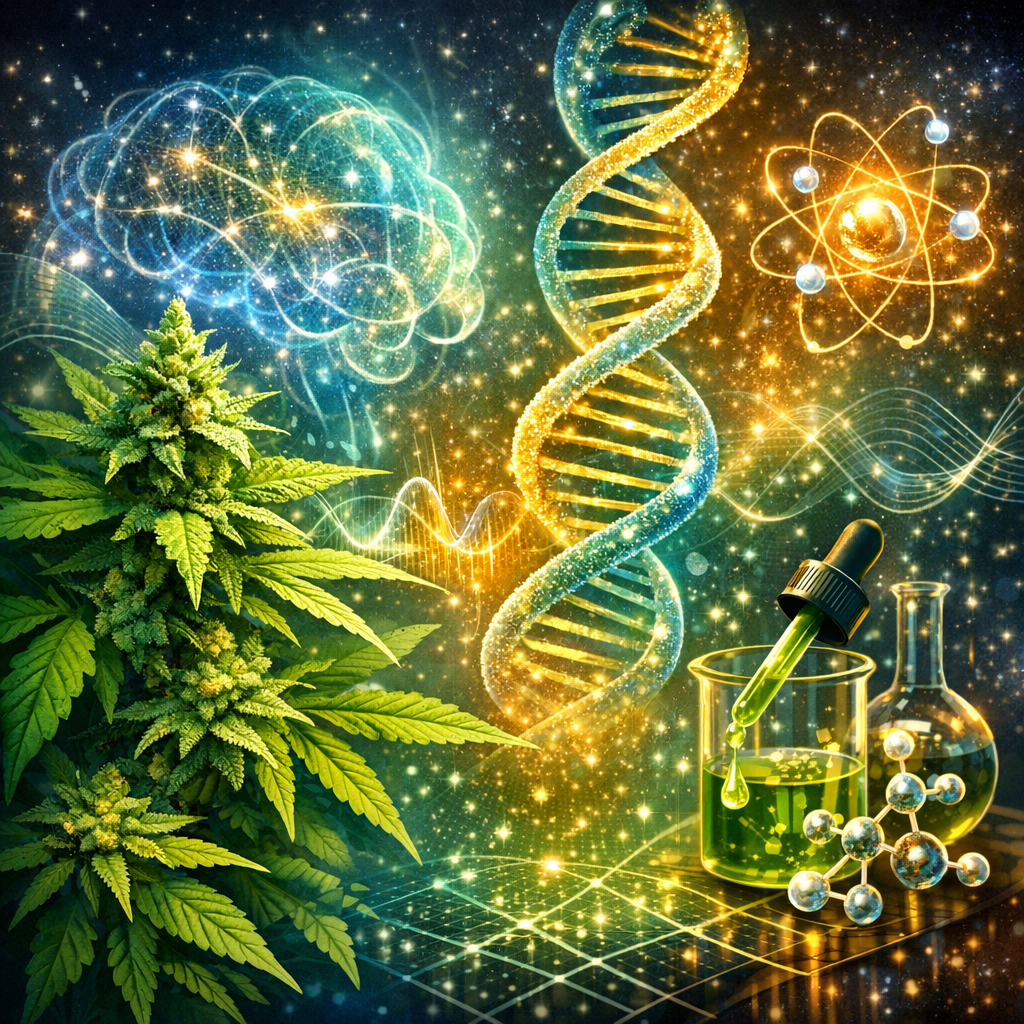
By integrating quantum biology into cannabis research, scientists aim to enhance the efficacy of cannabinoid-based therapies. One of the most promising avenues of exploration is the potential impact of quantum effects on the biochemical interactions within the endocannabinoid system. Quantum tunneling, for instance, could offer insights into how cannabinoids permeate cell membranes or interact with receptors, leading to faster and more targeted therapeutic outcomes.
Additionally, quantum biology might enable the precise modulation of cannabis compounds at the molecular level, producing customized medical cannabis products tailored to individual patient needs. This detailed understanding could revolutionize how we produce, prescribe, and consume cannabis, ensuring maximum therapeutic benefits with minimal side effects.
As both quantum biology and cannabis science are still burgeoning fields, the synergy between the two holds significant untapped potential. Continued research and experimentation are essential to unlock the deeper possibilities of this innovative approach. By delving into the quantum realm, researchers are poised to redefine the landscape of cannabis therapeutics, paving the way for advancements that could transform patient care globally.
Features:
Recent studies have begun shedding light on the convergence of quantum biology and cannabis therapeutics. One notable study explores how quantum tunneling might influence the psychoactive effects of THC. Researchers have hypothesized that quantum tunneling facilitates the rapid binding and activation of the cannabinoid receptors, potentially explaining how small doses can have significant effects. This phenomenon, primarily studied through advanced computational models, hints at the need for more in-depth exploration into the molecular dynamics at play.
Moreover, quantum coherence has been observed in photosynthesis, suggesting its role in optimizing energy transfer in complex environments. This discovery underscores the potential for similar processes within human biology, including the interactions between cannabinoids and neural networks. A 2021 study published in the journal [*Nature Physics*](https://www.nature.com/articles/s41467-018-06253-w) examined the extent of coherence phenomena in the brain, proposing that certain substances, like cannabinoids, might optimize neural communication through similar quantum effects. This insight could illuminate new paths for therapeutic interventions targeting neural disorders such as epilepsy and PTSD, where precise modulation of brain activity is crucial.
Another critical area of investigation is the role of quantum entanglement in the synergistic effects of cannabis compounds. Often termed the “entourage effect,” this refers to the increased biological response when multiple cannabinoids and terpenes are consumed together, as opposed to isolated compounds. Researchers posit that quantum entanglement might underpin the complex interactions that produce these enhanced effects, offering a framework to design more effective, full-spectrum cannabis products.
As these studies demonstrate, the application of quantum biology in cannabis therapeutics is not merely theoretical but grounded in emerging scientific evidence. While the field is in its nascency, the potential for quantum phenomena to explain and improve the action of cannabis-derived compounds offers an exciting frontier for medical research. By harnessing these quantum effects, cannabis therapy could become more precise, personalized, and efficacious, transforming it from a traditional remedy to a cornerstone of modern medicine.
Conclusion:
The integration of quantum biology with cannabis therapeutics promises to revolutionize the field, offering unprecedented insights into the optimization of cannabis treatments. As research into quantum phenomena progresses, the potential for breakthrough discoveries increases, potentially leading to innovative therapies that harness the full spectrum of cannabis compounds. This cutting-edge approach not only holds promise for enhanced medicinal efficacy but also sets the stage for a new era of personalized medicine, where each treatment is as unique as the patient it serves.
References:
1. [Quantum Biology: An Introduction](https://www.nature.com/articles/s41467-018-06253-w)
2. [The Endocannabinoid System and Its Modulation by Cannabinoids](https://www.ncbi.nlm.nih.gov/pmc/articles/PMC5877694/)
3. [Quantum Tunneling in Biology: From Enzymes to Quantum Biology](https://www.frontiersin.org/articles/10.3389/fmolb.2021.667868/full)
4. [Quantum Coherence in Photosynthesis](https://www.pnas.org/content/110/47/18797)
5. [Entourage Effect: A New Frontier for Multi-Target Drugs](https://www.frontiersin.org/articles/10.3389/fphar.2020.00022/full)
Concise Summary:
Emerging research indicates the potential of integrating quantum biology with cannabis therapeutics, promising significant advancements in medical science. Quantum phenomena like tunneling, coherence, and entanglement could enhance understanding and efficacy of cannabinoid interactions, optimizing therapies for conditions such as chronic pain, epilepsy, and PTSD. These developments could lead to personalized cannabis treatments, capitalizing on the plant’s full therapeutic spectrum. Continued research in this field could transform cannabis into a cornerstone of modern medicine, with targeted benefits and minimized side effects.