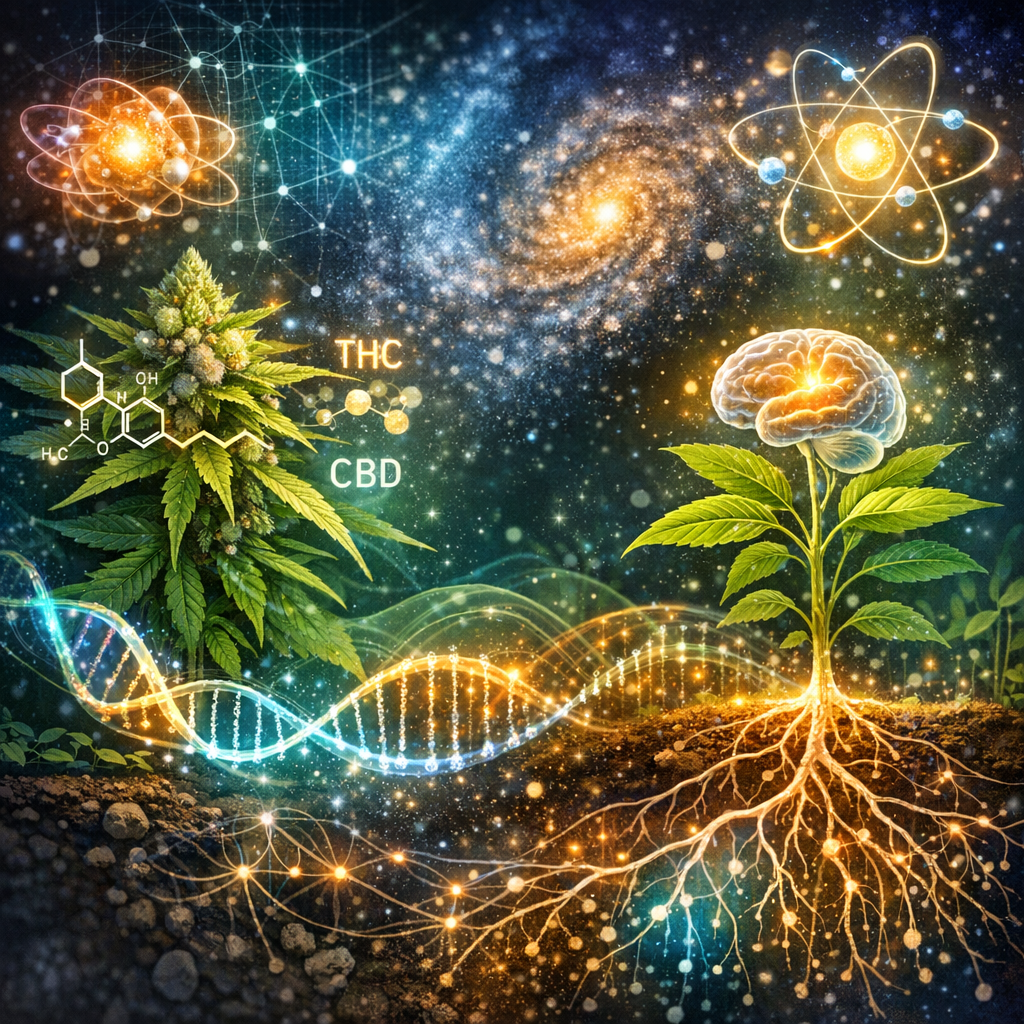
Quantum Biology Meets Cannabinoids: Unveiling the Biomechanics of Plant Intelligence
Introduction
The intersection of quantum biology and cannabinoids is an intriguing frontier that invites exploration into the depths of plant intelligence. Recent advancements in scientific research are beginning to unveil the subtle, sophisticated processes at the quantum level that govern plant life, particularly in cannabis. Traditionally, plants have been perceived as simple organisms, largely passive and responding mechanically to stimuli. However, this perception is rapidly evolving as researchers delve into the molecular intricacies of plant behavior, revealing a new dimension of complexity and responsiveness, often referred to as “plant intelligence.”
Quantum biology provides a framework to understand the non-linear, often surprising processes occurring within living organisms at the quantum level. It explores how quantum mechanics—a branch of physics dealing with subatomic particles—affects biological systems. Fascinatingly, this field sheds light on numerous unexplained phenomena, from the highly efficient energy transfer in photosynthesis to magnetic sensitivity in navigation.
When applied to cannabis, a plant that is already under intense scientific scrutiny for its therapeutic properties, quantum biology can illuminate the mysterious ways in which cannabinoids interact with living systems. Cannabinoids are a group of active compounds found in cannabis, with THC and CBD being the most well-known. These compounds exert their effects by interacting with the endocannabinoid system in humans, a complex cell-signaling system that plays a role in maintaining homeostasis.
Understanding the quantum biology of cannabinoids could potentially revolutionize how these compounds are used medicinally, enhancing their therapeutic efficacy and reducing side effects. This intersection also poses exciting questions about whether plants, specifically cannabis, possess a form of intelligence. Could plants like cannabis have evolved quantum processes to optimize the production of cannabinoids, enhancing their adaptability and survival?
Features
Several professional and medical studies are beginning to investigate the fascinating intersections between quantum biology and cannabinoids, paving the way for groundbreaking discoveries. A 2018 study published in the journal Nature explored the quantum coherence observed in photosynthesis. This coherence helps plants transfer energy nearly instantaneously and with minimal loss, offering insights into optimizing synthetic energy systems. Though not directly related to cannabinoids, it underlines the power of quantum mechanics in biological systems, enabling us to extend such understanding towards cannabinoid synthesis and interaction.
Furthermore, the study of biophotons—weak emissions of light radiated by biological organisms—reveals that plants might use quantum processes for communication and data processing. Research published in Progress in Biophysics and Molecular Biology suggested that biophotons might play a role in cellular communication and DNA repair. Applying this to cannabis, it raises questions about how cannabinoids could be part of a complex communication matrix guided by quantum mechanics, fundamentally altering how we understand plant intelligence and adaptability.
On the medical front, scientists are examining how quantum biology could optimize the interaction of cannabinoids with human biology. A study highlighted in the Journal of Cannabis Research explored the potential of quantum mechanics to create drugs that are precisely targeted, reducing unwanted side effects. Here, quantum mechanics could facilitate the development of cannabinoid-based therapies by predicting and manipulating how these compounds will behave at the cellular and molecular levels.
Additionally, the conversation about plant intelligence is evolving, with research indicating that plants exhibit behaviors reminiscent of decision-making, memory, and learning—all traditionally viewed as hallmarks of animal intelligence. The application of quantum principles to this research proposition aligns with the growing body of literature urging a reevaluation of how we classify intelligence across biological domains.
Conclusion
In conclusion, the convergence of quantum biology and cannabinoids opens a Pandora’s box of possibilities for both scientific understanding and practical applications in medicine and agriculture. While the theory of plant intelligence remains a vibrant field of debate, the potential for cannabinoids to influence this discourse is substantial. As our understanding deepens, it is conceivable that a significant reevaluation of biological systems—and our relationship with them—will emerge, reshaping the landscape of cannabinoid science forever.
Concise Summary
The fusion of quantum biology and cannabinoids is reshaping our understanding of plant intelligence and therapeutic applications. As quantum biology reveals life’s complexity at a molecular level, cannabis, especially for its cannabinoids THC and CBD, becomes a focal point. These insights may revolutionize cannabinoid use in medicine, making treatments safer and more effective. Studies uncover quantum mechanics’ role in energy transfer and cell communication, presenting cannabis as a sophisticated, responsive system. This exploration urges a reassessment of plant and animal intelligence, potentially transforming cannabinoid science and agricultural practices.