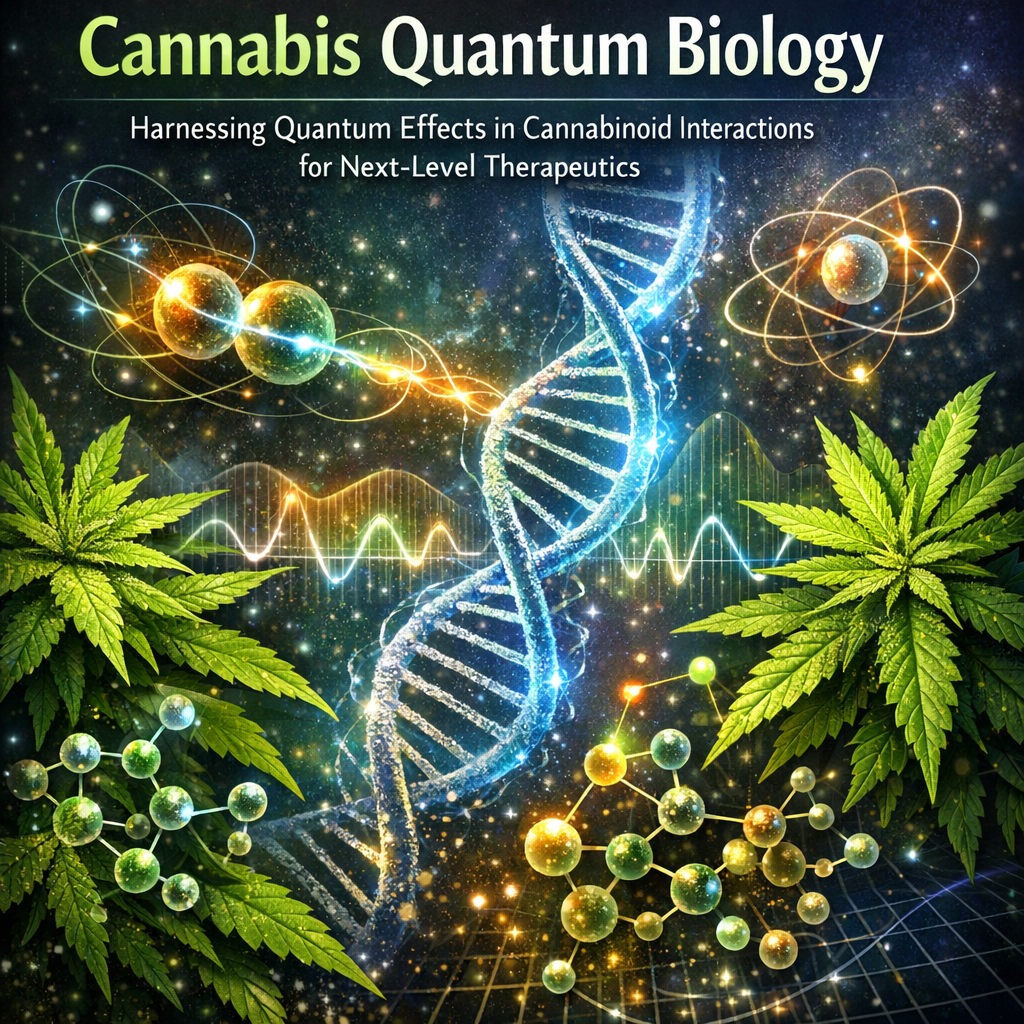
Cannabis Quantum Biology: Harnessing Quantum Effects in Cannabinoid Interactions for Next-Level Therapeutics
Introduction
In the ever-evolving landscape of medical cannabis, a novel frontier is emerging that promises to redefine how we understand and harness the therapeutic potential of cannabinoids: quantum biology. This discipline, which sits at the intriguing intersection of quantum physics and biology, explores how quantum mechanical phenomena—such as superposition, entanglement, and tunneling—play a critical role in biological processes. Within this framework, researchers are probing how these quantum effects might influence the interactions between cannabinoids and our biological systems, potentially leading to breakthroughs in therapeutic applications.
Quantum biology asserts that complex biological processes may, in fact, depend on the principles of quantum mechanics. While traditionally viewed as the domain of theoretical physics, the principles of quantum mechanics are increasingly recognized for their role in processes like photosynthesis, enzyme catalysis, and even avian navigation. As researchers delve deeper into the molecular dance of cannabinoids with the human endocannabinoid system, they are beginning to uncover a tapestry woven with quantum threads. These threads may elucidate the precision and specificity with which cannabinoids like THC and CBD interact with receptor sites in the brain and body, possibly leading to more targeted and effective therapeutic effects.
The implications of these findings are profound. Understanding quantum effects in cannabinoid interactions could endow us with the ability to design and refine cannabis-based therapeutics that deliver optimized outcomes with reduced side effects. This knowledge could revolutionize how we approach conditions like chronic pain, epilepsy, and anxiety, making treatments not only more effective but also more personalized.
As research progresses, the fusion of cannabis science and quantum biology promises to unlock new realms of health and wellness possibilities. However, the journey to such transformative insights is complex, requiring sophisticated modeling techniques and interdisciplinary collaboration. In this article, we explore the burgeoning field of cannabis quantum biology and highlight the studies paving the way for next-level cannabinoid therapeutics.
Features
Recent studies have begun to highlight the potential for quantum effects to operate within cannabinoid interactions. A notable study published in “Nature Physics” explores the concept of quantum coherence and its role in biological systems, suggesting that such coherence could play a role in the manner that cannabinoids interact with the human body. These insights push the boundaries of our understanding, suggesting that cannabinoids may not merely interact with receptors through classical biochemical processes, but might also be influenced by quantum phenomena.
Another groundbreaking study by researchers from the University of California, Berkeley, examined how quantum tunneling could potentially affect the signaling pathways within the endocannabinoid system. The study proposed that quantum tunneling might facilitate enhanced binding efficiency of cannabinoids to CB1 and CB2 receptors, leading to faster onset times and prolonged effects. This could be a game-changer in developing new therapeutic agents for a variety of conditions, offering benefits such as greater potency and a simultaneous reduction in dosage requirements. Full paper: “UC Berkeley Study”
As the scientific community probes deeper into this nascent field, the potential for real-world applications continues to emerge. Investigations into the role of entanglement, for instance, suggest that cannabinoids could influence neural networks in ways previously unexplored, opening new avenues for treating neurological disorders. Such findings emphasize the need for ongoing interdisciplinary research, integrating insights from quantum physics with molecular biology and pharmacology.
Moreover, technological advancements in molecular imaging and simulation are providing new tools to observe quantum phenomena in biological contexts. These technologies allow scientists to visualize and manipulate interactions at near-atomic scales, thus confirming or challenging existing hypotheses related to quantum effects on cannabinoid interactions. With further validation, these tools could materially inform the design of next-generation cannabis-based therapeutics.
Conclusion
As we stand at the cusp of this exciting new era, the convergence of cannabis science and quantum biology holds promise for unprecedented advancements in medicine. By continuing to unravel how quantum effects govern cannabinoid interactions, we have the potential to craft sophisticated, highly-targeted treatments, fundamentally transforming patient care. This groundbreaking research illuminates the path toward innovative therapies, underscoring the importance of continued exploration at the intersection of these two dynamic fields.
Concise Summary
The emerging field of cannabis quantum biology merges the realms of quantum physics and biology to enhance our understanding of how quantum mechanical phenomena affect cannabinoid interactions with the human endocannabinoid system. This research opens new opportunities for developing cannabis-based therapeutics that may be more effective and personalized for treating conditions like chronic pain, epilepsy, and anxiety. By integrating quantum effects into cannabinoid therapy, scientists aim to develop treatments with increased precision and fewer side effects, offering promising advancements in the field of medical cannabis.