Decoding the Entourage: How Minor Cannabinoids and Terpenes Create Cannabis Synergies Beyond THC and CBD
Introduction
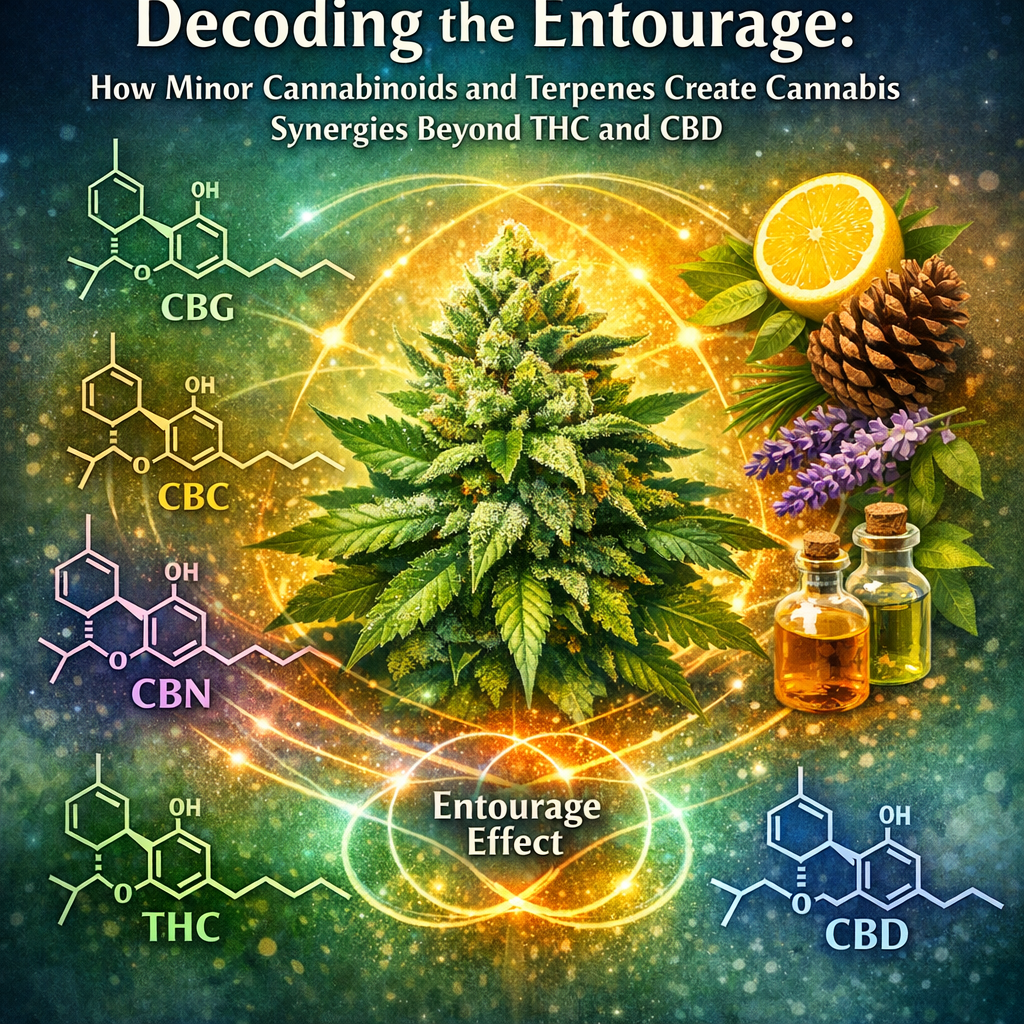
Cannabis is often associated with THC and CBD, the primary cannabinoids responsible for its psychoactive and therapeutic properties. However, focusing only on these two components may overlook the intricate chemistry of the cannabis plant, Cannabis sativa, which contains over 100 cannabinoids and 200 terpenes. These elements work synergistically to produce effects greater than their individual contributions, a phenomenon known as the entourage effect.
Coined by Dr. Raphael Mechoulam and his team in 1998, the entourage effect describes how cannabinoids and terpenes enhance each other’s therapeutic properties. While THC and CBD have dominated discussions, minor cannabinoids like CBG (cannabigerol), CBC (cannabichromene), and CBN (cannabinol), alongside numerous aromatic terpenes, are gaining recognition for their effects and benefits.
Although minor cannabinoids are present in smaller amounts, they possess powerful therapeutic attributes. For instance, CBG may offer anti-inflammatory and anti-bacterial properties, while CBC could assist in pain relief and anti-depressant effects. CBN, formed through the oxidation of THC, is explored for its sedative and appetite-stimulating qualities.
Terpenes, known for their aromatic contributions to cannabis, also play critical roles. These volatile molecules can influence cannabinoid absorption and effects, adding layers to the therapeutic outcome. For example, myrcene might enhance THC’s psychoactivity, while limonene potentially offers uplifting effects that align with CBD’s calming qualities.
Understanding and decoding the synergy of cannabis chemistry can revolutionize consumer and professional approaches, encouraging more tailored and effective applications for health and wellness.
Features
Research into the entourage effect is expanding. A study in the [British Journal of Pharmacology](https://bpspubs.onlinelibrary.wiley.com/doi/full/10.1111/j.1476-5381.2011.01238.x) explores how cannabinoid-terpene synergy could have therapeutic potential for conditions like pain, inflammation, anxiety, and epilepsy. This suggests that minor cannabinoids and terpenes can modulate and amplify each other’s effects, leading to nuanced cannabis therapeutics.
A study on pain management in [Frontiers in Neurology](https://www.frontiersin.org/articles/10.3389/fneur.2018.00426/full) highlights how THC’s analgesic effects are enhanced by other cannabinoids and terpenes. Whole-plant cannabis preparations preserve the plant’s chemical composition and provide superior pain relief compared to isolated THC or CBD, emphasizing the entourage effect.
The terpene pinene may enhance THC’s cognitive effects and act as a bronchodilator, while caryophyllene offers potential anti-inflammatory benefits by engaging cannabinoid receptors [source](https://www.ncbi.nlm.nih.gov/pmc/articles/PMC3165946/). Such interactions underscore cannabis as a customizable therapeutic agent.
Further research in [Cannabis and Cannabinoid Research](https://www.ncbi.nlm.nih.gov/pmc/articles/PMC5877694/) suggests formulations rich in minor cannabinoids and terpenes could address specific health issues, including anxiety, epilepsy, and neurodegenerative disorders. While more clinical trials are needed, the prospect of cannabis formulations tailored to individual needs is promising.
Conclusion
Recognizing the full spectrum of cannabinoids and terpenes allows for a deeper appreciation of cannabis’s potential. As synergies are decoded, future cannabis-centered therapies promise more personalized, effective health and wellness approaches. Embracing this complexity allows professionals and consumers to unlock cannabis’s full potential, surpassing THC and CBD limitations.
Ongoing scientific investigation and open discourse are crucial in navigating cannabis components. Understanding cannabis’s true power is just beginning, with limitless health and beyond applications.
Concise Summary
The article explores the complexity of cannabis, emphasizing the entourage effect—the synergy between cannabinoids and terpenes like CBG, CBC, and myrcene. Beyond THC and CBD, these components enhance therapeutic effects, with potential applications in pain management, inflammation, anxiety, and more. Research from sources such as the [British Journal of Pharmacology](https://bpspubs.onlinelibrary.wiley.com/doi/full/10.1111/j.1476-5381.2011.01238.x) and [Cannabis and Cannabinoid Research](https://www.ncbi.nlm.nih.gov/pmc/articles/PMC5877694/) provide insights into these interactions. As understanding grows, cannabis-centric therapies promise personalized health approaches, unlocking new potential beyond THC and CBD.