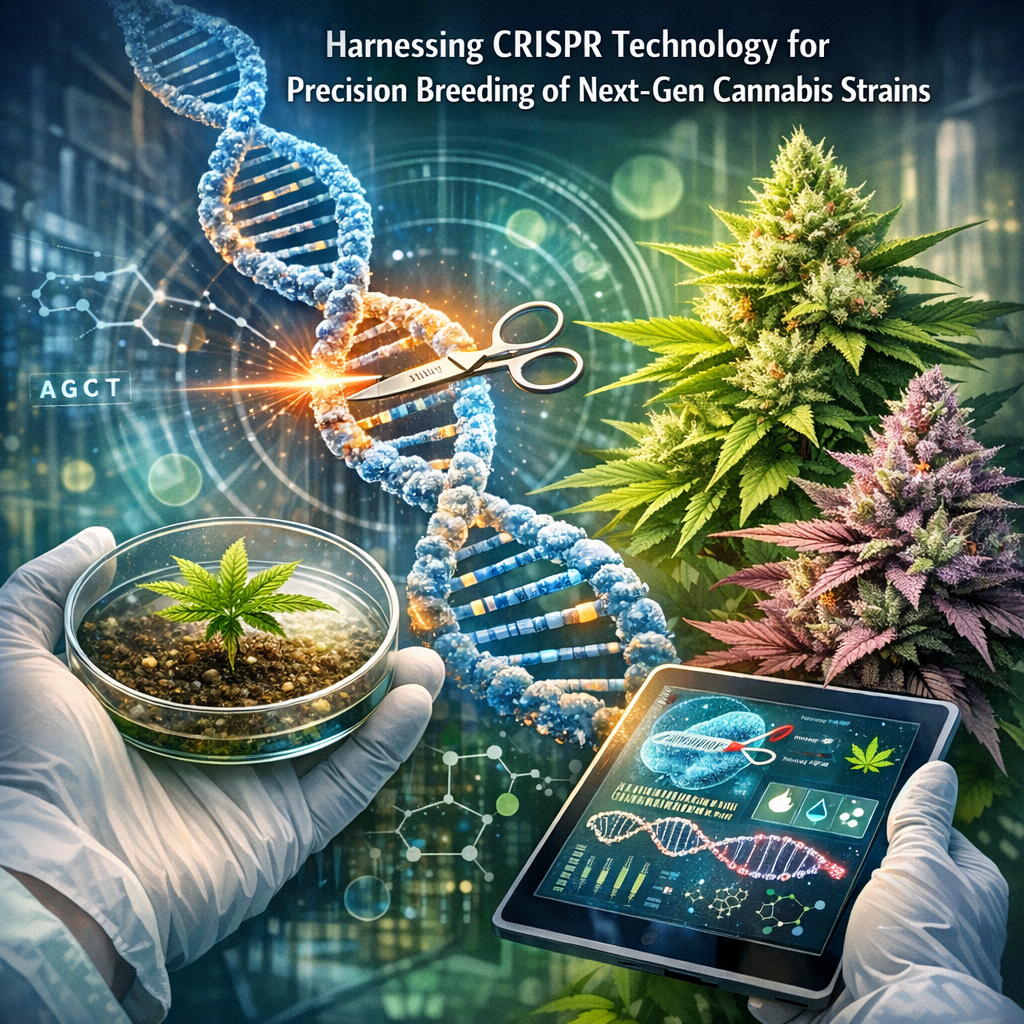
Harnessing CRISPR Technology for Precision Breeding of Next-Gen Cannabis Strains
The cannabis industry has transformed significantly over the last few decades, transitioning from an illicit substance to a commercial powerhouse driven by acceptance of both medical and recreational cannabis. This growth generates interest in developing new and improved strains. The advent of CRISPR/Cas9 technology introduces an exciting frontier for cannabis cultivation, promising unprecedented precision and efficiency in breeding. CRISPR, or “Clustered Regularly Interspaced Short Palindromic Repeats,” is a groundbreaking gene-editing tool that allows scientists to make precise changes to DNA sequences, potentially rewriting the plant’s genetic code.
The application of CRISPR in cannabis breeding is set to revolutionize development of new strains by targeting specific genetic traits with unparalleled accuracy. This opens new avenues for creating strains that are commercially valuable. To offer more insights, traditional cannabis breeding techniques have relied on selective methods, which are time-intensive and based on trial-and-error. CRISPR allows breeders to directly target the genes responsible for desirable traits, significantly reducing time and resources.
Beyond breeding, CRISPR can be used to develop strains tailored for specific medical conditions by optimizing levels of therapeutic compounds like CBD and THCV. Additionally, the precise regulation of terpene profiles enables improved flavor and aroma, important factors for consumers. Furthermore, CRISPR could mitigate the environmental impact of cannabis cultivation by creating strains better suited for various climates and requiring less water.
CRISPR can also suppress less desirable traits, such as susceptibility to pests and diseases. As the cannabis market expands, the demand for refined strains will grow, making CRISPR invaluable for producers wanting competitive advantages. While promising, the technology faces challenges, including regulatory hurdles and public perceptions. Forward-thinking in the industry requires balancing technological progress with ethical considerations.
Features: Recent Studies and Applications
Recent research emphasizes CRISPR’s capabilities in precision breeding. Notable studies, like one published in the journal “Planta,” demonstrate successful CRISPR/Cas9 editing of Cannabis sativa, targeting genes involved in flowering time and cannabinoid production. This milestone showcases how gene-editing can alter the plant’s biological pathways for user or medical benefits. Planta Study
CRISPR’s role in enhancing disease resistance has also been a focus. With the crop susceptible to mold, fungi, and pests, robust strains would reduce growers’ losses. An article from ”Frontiers in Plant Science” outlines how CRISPR boosts the plant’s natural defenses against pathogens, essential for organic farming and reduced pesticide reliance. Frontiers in Plant Science
Commercially, modifying terpene profiles via CRISPR is lucrative. Terpenes contribute to unique flavors and aromas and can enhance therapeutic effects with cannabinoids, known as the ”entourage effect.” Research in ”Nature Communications” shows CRISPR’s efficacy in manipulating terpene biosynthesis pathways, allowing cultivation of strains to specific consumer and market demands. Nature Communications
Navigating complex regulatory landscapes is necessary for adopting CRISPR in cannabis breeding, especially with regards to GMOs. Open discussions and transparent practices will be vital in gaining public trust and ensuring the technology’s benefits are achieved responsibly.
Conclusion
As CRISPR technology integrates into cannabis breeding, it promises to reshape the industry, fostering unprecedented strain innovation and customization. Despite technical and regulatory challenges, the allure of precisely tailored cannabis solutions driven by genetic engineering is compelling. Navigating these challenges will be crucial, but CRISPR offers a robust toolkit aligning innovation with nature to meet evolving consumer and professional expectations.
Concise Summary:
The application of CRISPR/Cas9 in cannabis breeding is revolutionizing the industry, enabling precise genetic alterations to develop strains with specific desirable traits, such as customized cannabinoid levels and increased disease resistance. This cutting-edge gene-editing technology promises faster and more efficient breeding processes, significant for both medical and commercial use. Research highlights its potential in optimizing beneficial characteristics and mitigating environmental impacts. While challenges like regulatory hurdles persist, CRISPR offers a promising future in tailored cannabis cultivation, aligning technological advancement with ethical responsibility.