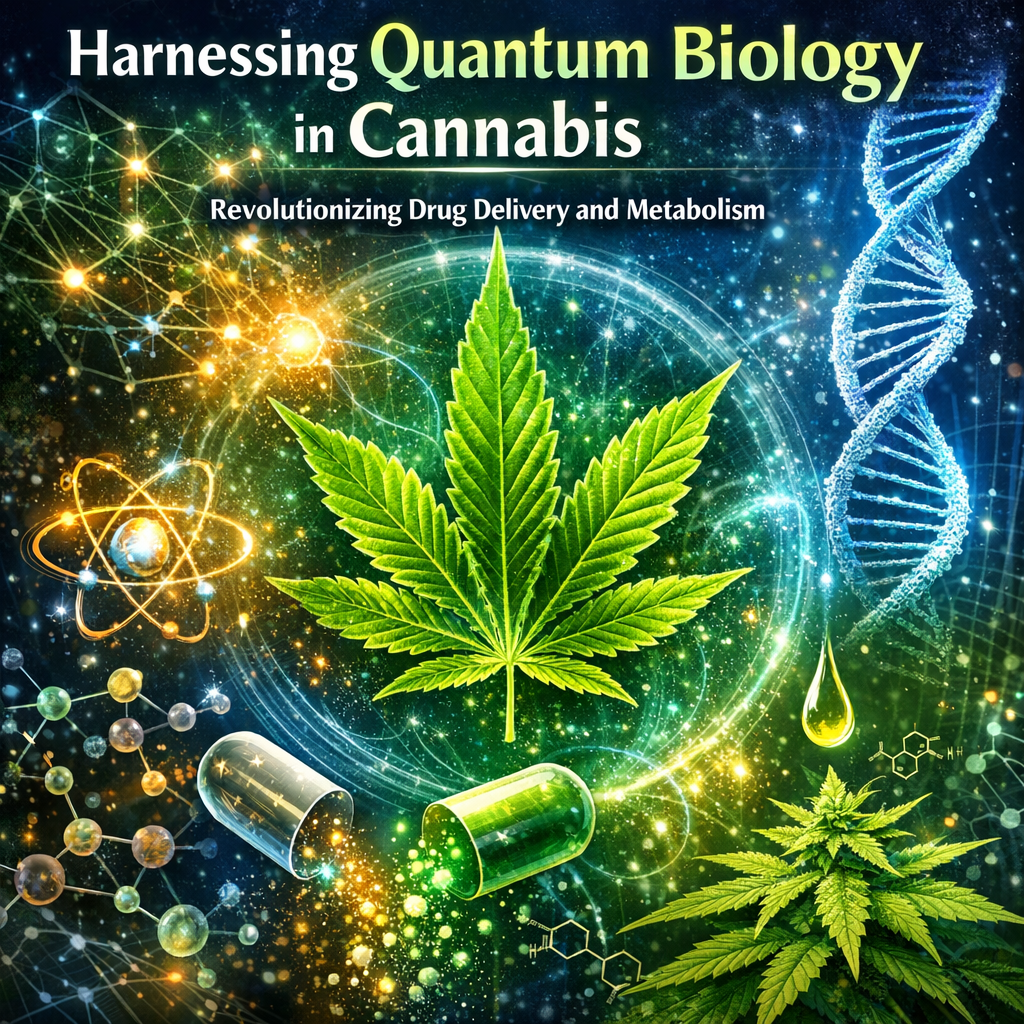
Harnessing Quantum Biology in Cannabis: Revolutionizing Drug Delivery and Metabolism
Introduction
As the world of cannabis research evolves from stigma to scientific scrutiny, innovative technologies are shaping the future of cannabis-based treatments. One groundbreaking advancement is the integration of quantum biology, which seeks to explain biological phenomena using quantum mechanics principles. This field promises new possibilities in enhancing drug delivery mechanisms and understanding complex metabolic processes. By unlocking quantum phenomena in biological systems, it paves the way for more effective and tailored cannabis therapies.
Quantum biology delves into how quantum mechanics impacts biological processes, aiming to advance traditional pharmacology. Current drug delivery systems focus on ensuring correct doses reach their biological targets efficiently. Through insights from quantum biology, novel drug delivery systems can be developed to precisely target specific cells or tissues, optimizing therapeutic outcomes.
The metabolism of cannabis involves the conversion of cannabinoids such as THC and CBD through enzymatic reactions, primarily governed by the cytochrome P450 (CYP) enzyme family. Emerging research suggests quantum effects could play a critical role in these processes. For instance, the behavior of electrons at the quantum level might affect CYP enzymes’ ability to metabolize cannabinoids, influencing both the duration and intensity of cannabis effects. This perspective could lead to personalized treatments based on an individual’s metabolic characteristics.
Moreover, quantum biology could elucidate the entourage effect, the synergistic interplay between various cannabis compounds. Previously elusive to conventional methods, this complex interaction can be understood through the quantum biological lens, potentially revolutionizing our perception of cannabis efficacy. Scientists may harness quantum biology to create specialized cannabis strains or formulations, maximizing benefits and minimizing side effects.
Features
Recent scientific studies suggest potential applications of quantum biology in enhancing cannabis drug delivery systems and metabolism. A pivotal study published in [Nature Communications](https://www.nature.com/articles/ncomms14767) explored quantum tunneling—a fundamental quantum mechanic concept—in enzyme-catalyzed reactions, including those performed by the CYP family. Quantum tunneling enables particles to pass through energy barriers, potentially explaining enzymes’ efficacy in metabolizing cannabinoids, offering a more nuanced understanding of drug metabolism and detoxification.
Further research has examined quantum coherence in energy transfer processes within biological systems. Efficient energy transfer is crucial for cellular uptake of drugs. If cannabis compounds can be delivered more efficiently using mechanisms informed by quantum coherence, it could significantly enhance bioavailability and therapeutic impact. Studies published in [Proceedings of the National Academy of Sciences (PNAS)](https://www.pnas.org/content/116/18/8753) highlight quantum coherence’s potential in optimizing these processes.
Moreover, exploring quantum entanglement, wherein interconnected particles’ states affect one another, might provide insights into the entourage effect. [American Institute of Physics](https://aip.scitation.org/doi/10.1063/1.4903839) research suggests that interactions among cannabis compounds with biological targets could be elucidated through quantum entanglement, offering a novel framework for cannabis pharmacodynamics. These advancements pave the way for innovative cannabis processing techniques, ultimately contributing to precision medicine in cannabis therapeutics.
Conclusion
The fusion of quantum biology and cannabis research heralds a new era of innovation in drug delivery and metabolism. By unraveling the quantum processes underlying biological interactions, more precise, efficient, and personalized cannabis therapies can be developed. This burgeoning field not only enhances our understanding of cannabis pharmacology but also opens new horizons for therapeutic applications, transforming how we harness the plant’s medicinal potential for consumers and professionals alike.
Summary
The integration of quantum biology with cannabis research is transforming drug delivery and metabolism. By explaining complex biological interactions using quantum mechanics, scientists can develop more effective and personalized cannabis therapies. Emerging research highlights roles of quantum tunneling, coherence, and entanglement in optimizing drug delivery and understanding metabolism. These advancements may also elucidate the entourage effect, enhancing efficacy while minimizing side effects. As this field unfolds, it offers new pathways for therapeutic applications, reshaping how we harness cannabis’s medicinal potential.