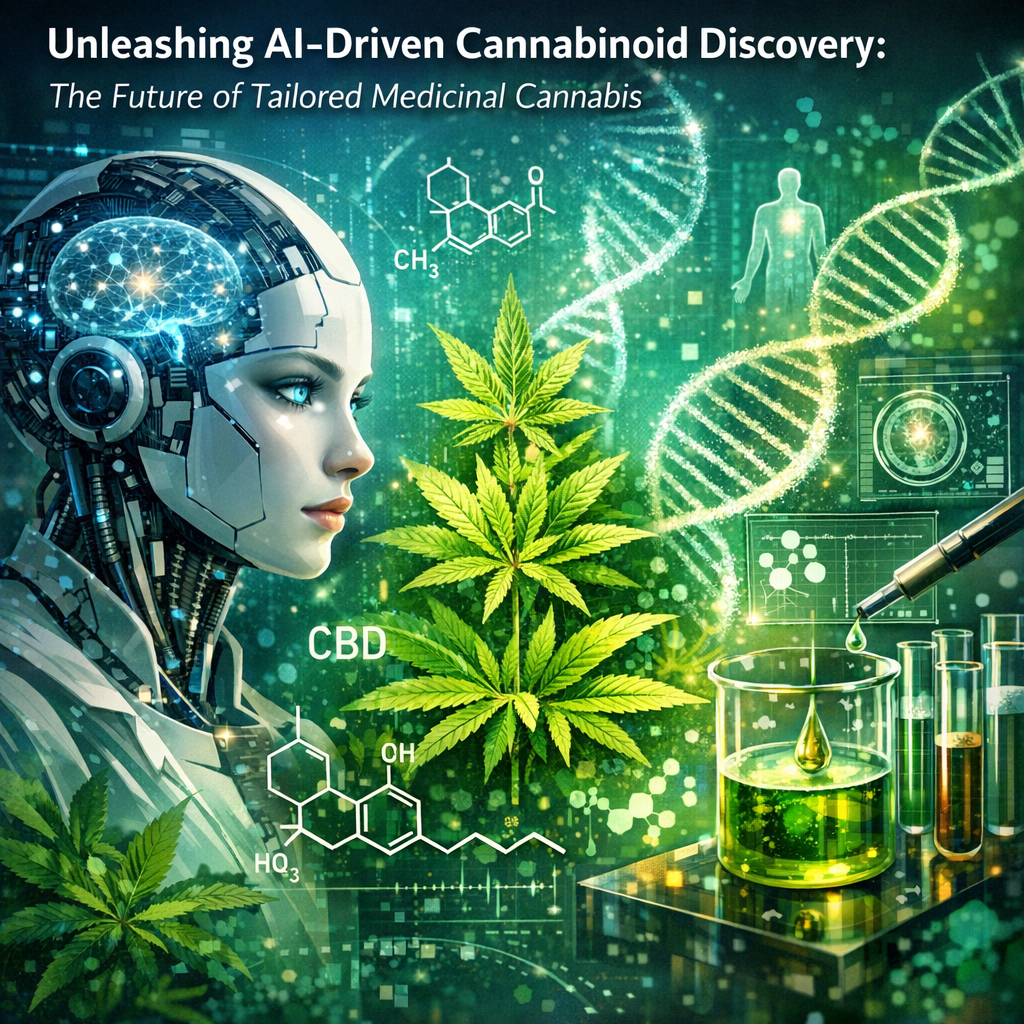
Unleashing AI-Driven Cannabinoid Discovery: The Future of Tailored Medicinal Cannabis
Introduction
The evolving landscape of medicinal cannabis is witnessing a remarkable transformation with the advent of artificial intelligence (AI). Historically, the journey of cannabis from ancient herbal remedy to modern medicinal powerhouse has been marked by a growing understanding of cannabinoids—the active compounds found in the plant. However, the discovery and targeted application of these cannabinoids have traditionally been a labor-intensive process. Today, AI is heralding a new era, offering unprecedented potential in expediting cannabinoid research, optimizing cultivation, and personalizing patient treatment plans.
Artificial intelligence, with its ability to analyze vast datasets and detect complex patterns, is unlocking new frontiers in cannabinoid research. In the context of cannabis, AI’s role extends to identifying previously unknown cannabinoids, predicting their potential therapeutic effects, and tailoring cannabinoid profiles to meet specific medical needs. This not only accelerates the pace of discovery but also enhances precision in developing treatments tailored to individual nuances and conditions.
Traditionally, the discovery of cannabinoids and their effects involved cumbersome processes that relied heavily on experimental research and human expertise. With AI, researchers can now simulate these processes, running myriad theoretical experiments and predictions in a fraction of the time it would take manually. For patients, this accelerates the development of more effective, customized treatments, reducing the trial-and-error period often associated with cannabis therapy.
AI’s impact is also tangible in cannabis cultivation. Cannabinoids such as THC and CBD are influenced by numerous factors including strain genetics, growth environments, and harvesting processes. AI systems can optimize these variables, enhancing product consistency and driving innovations in strain development. Moreover, AI-driven platforms are poised to transform how we understand cannabis pharmacology, offering insights into interactions between multiple cannabinoids and terpenes, which could unlock new dimensions of synergy commonly referred to as the “entourage effect”.
Features
Several studies have already highlighted the capabilities of AI in cannabinoid research and development. One notable example is a study conducted by McPartland et al., where researchers used AI algorithms to identify new cannabinoids effectively. Their AI models leveraged existing databases, drawing correlations between genetic sequences and cannabinoid biosynthetic pathways, thereby predicting both potential new cannabinoids and their possible pharmacological effects. For more on this study, visit [McPartland’s Study](https://www.nature.com/articles/s41598-019-56742-5).
Furthermore, the application of AI in efficient strain development has been evidenced by researchers at Scheuer et al., who utilized machine learning to optimize the growing conditions for cannabis plants. Their models accounted for variables such as light, water, and nutrient supply, optimizing the balance to enhance specific cannabinoid concentrations. This not only boosts yield but ensures that the medicinal properties of the plant are maximized for specific therapeutic applications. For further details, see [Scheuer’s Study](https://www.frontiersin.org/articles/10.3389/fpls.2020.00361/full).
The prospect of AI in personalizing cannabis-based treatments is particularly promising when considering its potential synergy with genomics. AI algorithms are being developed to analyze patients’ genetic profiles alongside cannabis strain data to recommend specific cannabinoid formulations for personalized medicine. Projects like those undertaken by companies such as Emerald Health Therapeutics are indicative of progress. Emerald employs AI to provide recommendations based on personal health data and cannabis product characteristics, paving the way for bespoke treatment plans that cater to individual genetic predispositions and medical histories. More information can be found at [Emerald Health Innovations](https://www.emeraldhealthbio.com/).
AI’s ability to simulate interactions between different cannabinoids and terpenes also offers exploration into the “entourage effect.” By predicting how these compounds work synergistically, scientists hope to develop new strains or products that amplify the therapeutic benefits of cannabis, offering more comprehensive solutions for complex medical conditions. As these AI technologies mature, the prospect for refined, targeted interventions in conditions such as chronic pain, epilepsy, and even mental health disorders becomes increasingly tangible.
Conclusion
The integration of artificial intelligence in cannabinoid discovery and cannabis research marks a pivotal shift towards precision medicine. As AI continues to redefine possibilities, it holds the potential to revolutionize how cannabis is cultivated, understood, and applied in a medical context. This fusion promises a future where medicinal cannabis can be tailored to individual patient needs, maximizing therapeutic efficacy and minimizing adverse effects, thereby enhancing patient outcomes and elevating the standard of personalized care.
For readers interested in further exploring these advancements, integrating AI-driven insights into clinical practice will undoubtedly shape the next decade of cannabis research and its application in healthcare.
References
– McPartland, J. M., et al. (2019). Can phytocannabinoids be transported through the blood brain barrier? Implications for potential endocannabinoid therapeutics. Available at [Nature.com](https://www.nature.com/articles/s41598-019-56742-5).
– Scheuer, T., et al. (2020). Application of Machine Learning in Cannabis Cloning and Cultivation. Available at [Frontiers in Plant Science](https://www.frontiersin.org/articles/10.3389/fpls.2020.00361/full).
– Emerald Health Therapeutics. Personalized Cannabinoid Therapy Innovations. Visit [Emerald Health Innovations](https://www.emeraldhealthbio.com/).
Concise Summary
Artificial intelligence is revolutionizing medicinal cannabis by expediting cannabinoid discovery, optimizing cultivation, and personalizing treatment. AI systems analyze vast data sets to predict therapeutic effects, tailor cannabinoid profiles for specific needs, and transform cultivation processes. Studies like those by McPartland et al. and Scheuer et al. highlight AI’s role in uncovering new cannabinoids and optimizing growth conditions. Companies like Emerald Health leverage AI for personalized treatment plans. As AI matures, it promises to enhance therapeutic efficacy, streamline cultivation, and open new avenues for understanding cannabis pharmacology, including the entourage effect.