Redefining Crop Efficiency: How Quantum Dots Could Revolutionize Cannabis Cultivation
Introduction
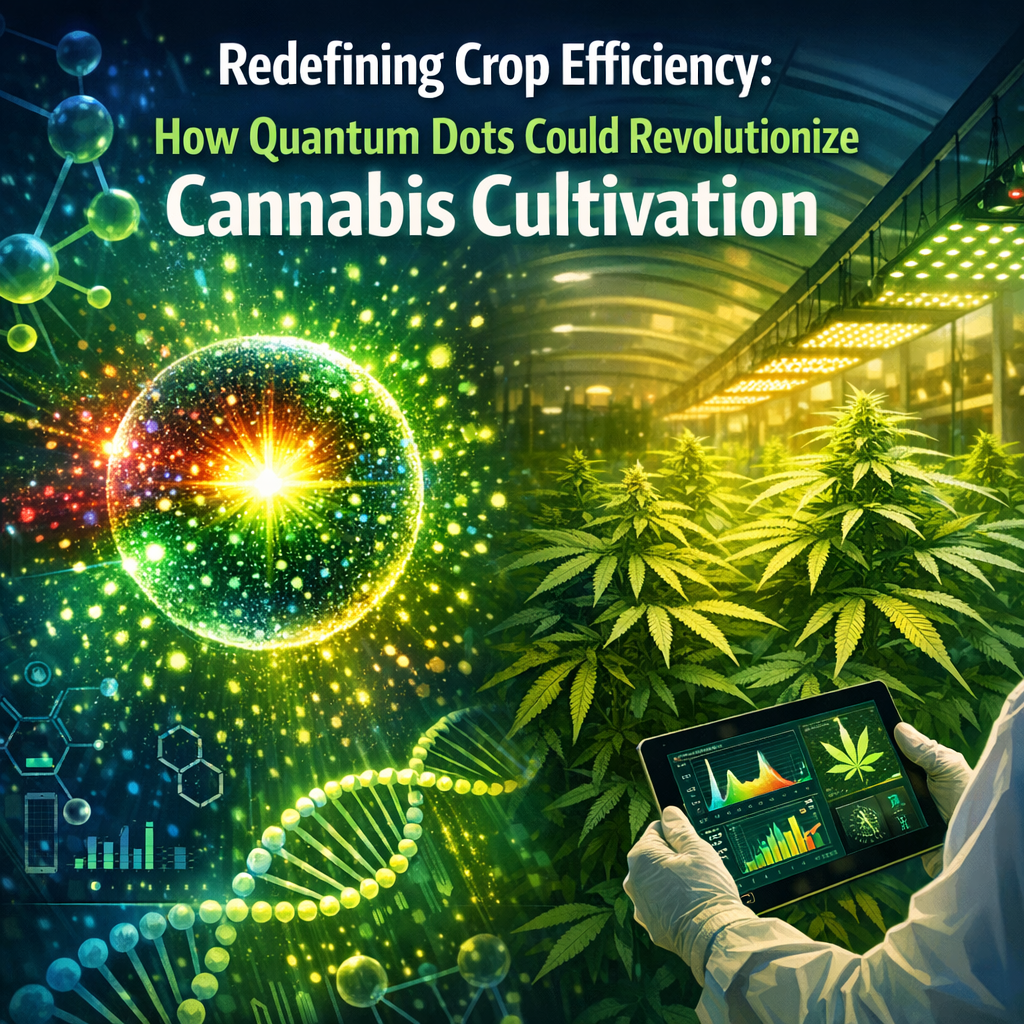
The cannabis industry has seen unprecedented growth in recent years, driven largely by increased legalization, rising consumer demand, and scientific innovation. As the market expands, so does the need for more efficient and sustainable agricultural practices. Enter quantum dots—a frontier technology that promises to transform cannabis cultivation. Quantum dots are nano-sized semiconductor materials that possess unique optical and electrical properties, which can be harnessed to enhance plant growth and maximize yields.
Quantum dots are tiny, fluorescent particles capable of manipulating light by either emitting it at precise wavelengths or converting it into energy for plant use. Unlike traditional agricultural methods that depend heavily on natural sunlight, quantum dots offer the potential to create ‘smart’ cultivation environments where light can be engineered to enhance key stages of plant growth, such as seedling development, flowering, and cannabinoid production. This precision lighting could revolutionize how cannabis plants are grown by optimizing photosynthesis, improving resource efficiency, and reducing the carbon footprint associated with indoor farming.
Given the cannabis plant’s light sensitivity, quantum dots present an invaluable opportunity to tailor specific light spectra that cater to the plant’s needs. One of the most pivotal aspects of cannabis cultivation is optimizing the photosynthetic process, and precise control over light input can exponentially increase yields and potency. Furthermore, these nanomaterials could help cultivators adapt to varying environmental conditions by reducing reliance on natural factors like sunlight availability, which is unpredictable and may not always align with crop needs.
The introduction of quantum dots aligns with the industry’s aim to adopt more sustainable practices. As energy consumption remains a critical concern in indoor cannabis cultivation, utilizing quantum dots to modify lighting systems could considerably reduce electricity usage, thereby cutting costs and CO2 emissions. This technology not only holds promise for commercial growers seeking efficient and sustainable methods but also for medical and niche cannabis markets that demand high-quality, consistent products. As research into quantum technology progresses, its applicability to agriculture, especially cannabis cultivation, opens up a realm of possibilities that could redefine the norms of crop efficiency in the coming years.
Features
Numerous studies lay the foundation for applying quantum dots in agriculture, highlighting their potential to revolutionize crop production by enhancing plant photonics, which entails the management of light used for photosynthesis. A study published in [Nature Communications](https://www.nature.com/articles/s41467-020-20417-4) demonstrated how quantum dots could be tuned to emit specific wavelengths of light that optimize photosynthetic activity in plants, leading to up to 30% greater biomass production compared to traditional lighting. Such findings are particularly relevant for cannabis cultivators who seek to maximize plant size and cannabinoid yields.
Research from the journal [Nano-Micro Letters](https://www.springer.com/journal/40095) indicates that quantum dots can also reduce the energy footprint of cultivation facilities. By selecting the appropriate semiconductor materials, quantum dots can convert common indoor lighting into spectra that mimic optimal sunlight conditions. The more efficient light absorption reduces the need for extensive artificial lighting systems, which are energy-intensive and costly. This efficiency is crucial in cannabis cultivation, where high energy costs typically impact profitability.
Moreover, a study in the [American Journal of Plant Physiology](https://www.ajplantphysiology.com/) examined the role of quantum dots in stress mitigation, showcasing that plants exposed to engineered light from quantum dots exhibited increased resilience to environmental stressors such as drought and temperature fluctuations. For the cannabis industry, where climate control is essential, using quantum dots could lead to more stable and resilient crops, ensuring consistent quality and potency despite external environmental variations.
Finally, ongoing studies are exploring how quantum dots could be used to engineer synthetic responses to light in plants, effectively tricking them into thinking they’re under more favorable growing conditions even if they are not. This capability provides cannabis professionals with an innovative tool to manipulate and extend growing seasons or increase the yield of specific cannabinoids depending on the desired product outcome.
Conclusion
Quantum dots stand at the forefront of a promising future in cannabis cultivation. By offering refined control over the light environment, they not only improve plant growth and resource efficiency but also align with sustainability objectives vital for modern agriculture. As research into quantum technologies continues to advance, their integration into cannabis farming could establish new benchmarks for crop efficiency, quality, and environmental stewardship. Embracing quantum dots could very well be a transformative stride for the cannabis industry, offering a glimpse into the future of agriculture.
Concise Summary
The implementation of quantum dots in cannabis cultivation offers a revolutionary approach to enhancing plant growth and sustainability. These nano-sized semiconductors manipulate light, optimizing photosynthesis, and boosting yields, while decreasing energy consumption and greenhouse emissions. Quantum dots provide tailored light environments to improve critical growth stages like seedling development and cannabinoid production. Research shows these materials can bolster plant resilience against environmental stress, offering consistent and high-quality yields. As quantum technology develops, its application in cannabis farming may set new standards for agricultural efficiency and environmental stewardship, unveiling vast potential for the industry’s growth.