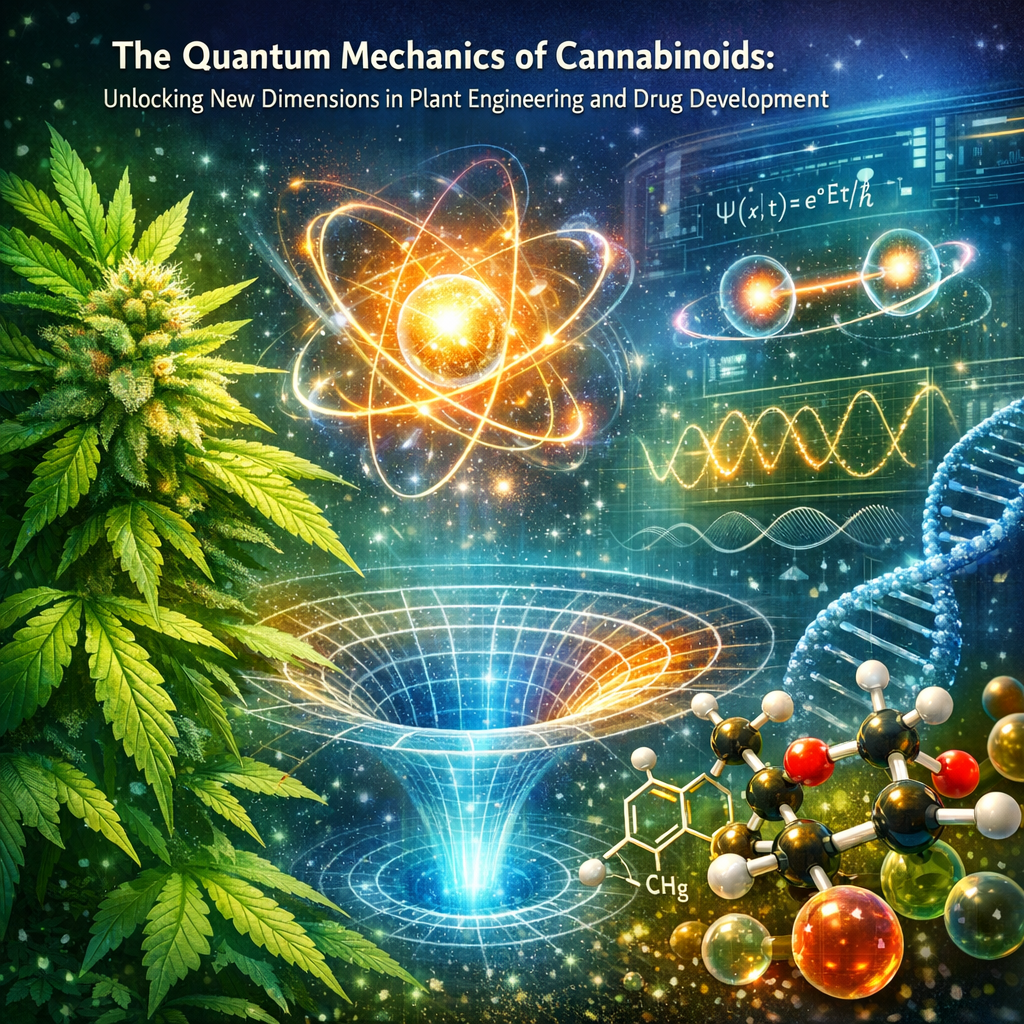
The Quantum Mechanics of Cannabinoids: Unlocking New Dimensions in Plant Engineering and Drug Development
As our understanding of quantum mechanics deepens, its application to fields once considered purely biological unlocks new pathways for innovation and discovery. One such field experiencing a renaissance is cannabis science. Traditionally viewed through a biochemical lens, cannabinoids—the active compounds of the cannabis plant—are increasingly seen through the prism of quantum mechanics. This shift holds the potential to revolutionize both plant engineering and drug development, offering more precise and effective therapeutic options.
Cannabinoids, including tetrahydrocannabinol (THC) and cannabidiol (CBD), interact with the endocannabinoid system in the human body, influencing processes like mood, pain sensation, and immune function. What quantum mechanics offers is a deeper understanding of these interactions at the molecular level. Unlike classical chemistry, which deals with set energies and volumes, quantum mechanics allows scientists to explore the probabilistic nature of molecules and their behaviors at the atomic scale. This could lead to the customization of cannabinoids at this level, engineering compounds to produce specific therapeutic effects.
Moreover, the quantum approach enables the modeling of drugs that can operate with unprecedented precision within our biological systems. Quantum mechanics opens the prospect of designing “designer cannabinoids” that can target specific pathways in the body with minimal side effects. This has vast implications for the medical cannabis industry, potentially offering more personalized treatment options for conditions ranging from chronic pain to neurological disorders.
The integration of quantum studies into cannabis research also offers the possibility of optimizing plant growth and potency. Quantum biology, which examines the quantum phenomena within biological processes, provides a framework for understanding how plants convert sunlight into chemical energy. By applying these principles, scientists hope to enhance the efficiency of photosynthesis in cannabis plants, leading to increased yields and stronger cannabinoid profiles.
Features: Recent Studies and Applications
A study conducted by researchers at the Massachusetts Institute of Technology (MIT) and presented in the journal [*Nature Physics*](https://www.nature.com/articles/nphys2873) explores how quantum processes can affect chemical reactions, including those involved in plant biology. This research has implications for understanding how cannabinoids are produced and can be manipulated at a molecular level. The study suggests that through techniques like quantum tunneling, we may one day alter the ways plants synthesize these complex molecules, possibly leading to newer cannabis strains with enhanced qualities.
Another notable study from the University of California, Berkeley, published in the [*Journal of the American Chemical Society*](https://pubs.acs.org/journal/jacsat), examines the quantum mechanical behavior of bioactive molecules, such as cannabinoids. Researchers found that by leveraging quantum theory, it is possible to predict the behavior of these molecules more accurately in the human body, paving the way for new compounds that could offer enhanced therapeutic properties without the psychoactive effects typically associated with THC.
On the practical side of plant engineering, advanced quantum simulations are being employed to better understand and improve the carbon fixation process in cannabis plants through more efficient light energy usage. These insights aim to innovate cultivation methods, making them more sustainable and efficient. Additionally, there are ongoing studies into how quantum computing, with its superior processing power, can be utilized to model complex biological systems involved in cannabinoid synthesis and interaction.
Such breakthroughs are not just theoretical. Companies at the cutting edge of this research are already exploring how to harness quantum computing to streamline the drug development process, reducing the time and cost associated with bringing new cannabis-based pharmaceuticals to market.
Conclusion: Integrating Science and Medicine
The confluence of quantum mechanics with cannabinoid research represents a frontier ripe with opportunities for innovation in plant engineering and drug development. By embracing these cutting-edge scientific principles, we can refine our understanding of how cannabinoids function and are produced, ultimately leading to more effective, targeted, and personalized therapies. As this interdisciplinary approach continues to flourish, it promises to deliver unprecedented advances in both the cultivation and application of cannabis, heralding a new era of medical and scientific breakthroughs.
Summary: The exploration of quantum mechanics in cannabis science is revolutionizing both plant engineering and drug development, allowing for precision-driven innovations. By understanding cannabinoids’ interactions at a molecular level, scientists can design “designer cannabinoids” tailored for specific therapeutic outcomes, minimizing side effects. Additionally, quantum biology enhances plant cultivation, optimizing photosynthesis for greater yields. Recent studies at MIT and Berkeley underscore the potential of such approaches, suggesting quantum-enhanced methodologies can refine cannabinoid synthesis and bioactivity modeling. As quantum computing integrates into cannabis research, more personalized, efficient therapies will emerge, transforming medical cannabis applications.