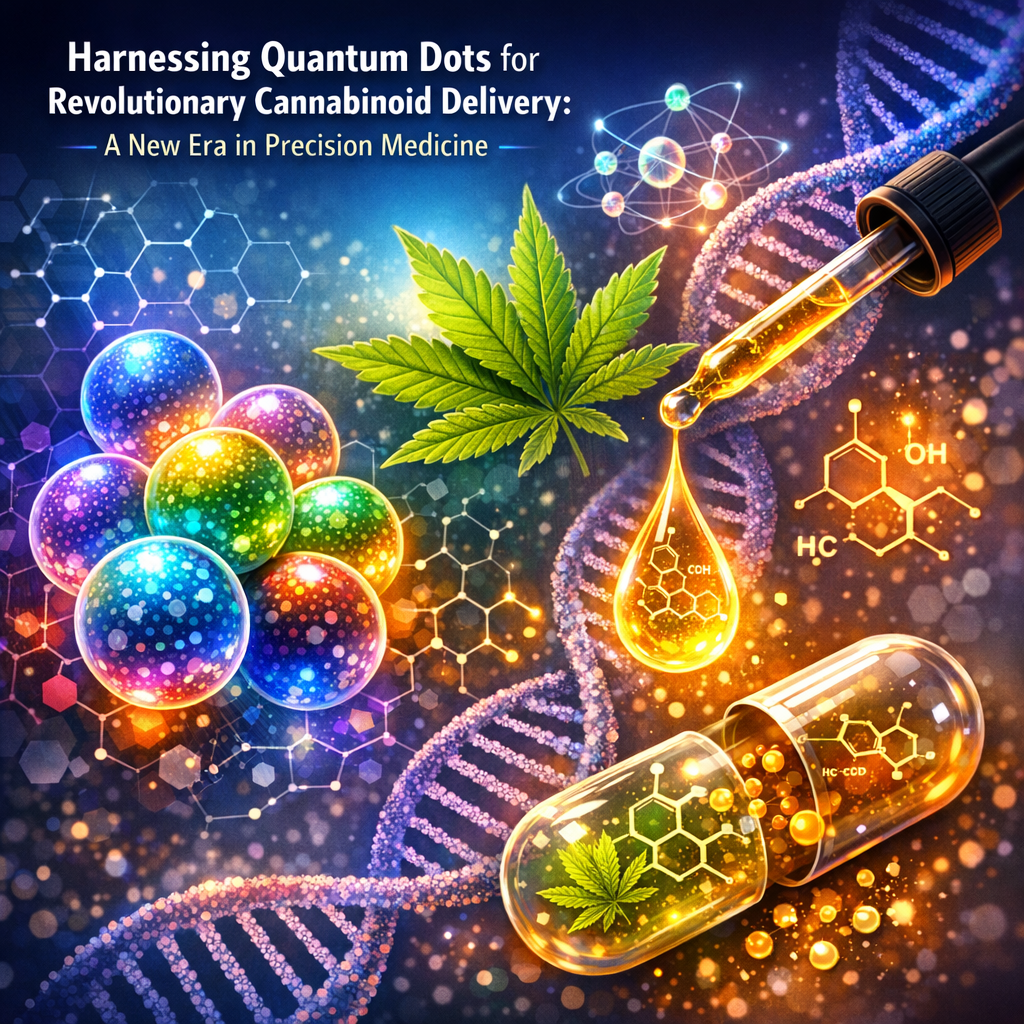
Harnessing Quantum Dots for Revolutionary Cannabinoid Delivery: A New Era in Precision Medicine
*Introduction*
In the rapidly evolving world of cannabis research, new technologies and innovations are continuously reshaping how we understand and utilize cannabinoids. One such groundbreaking advancement is the potential use of quantum dots in cannabinoid delivery, promising a new era of precision medicine. Quantum dots are nanoscale semiconductor particles with unique optical and electronic properties, making them invaluable in various fields such as medical imaging, quantum computing, and now, precision drug delivery.
Cannabinoids like THC, CBD, and their lesser-known counterparts have shown significant therapeutic potential across a range of conditions, from chronic pain and epilepsy to anxiety and inflammation. However, one of the major challenges in cannabinoid therapy is delivering these compounds precisely and efficiently to their target sites in the body. Traditional delivery methods often suffer from low bioavailability and inconsistent dosing, limiting their effectiveness and ease of use.
Enter quantum dots as a revolutionary solution. These tiny particles, often no more than a few nanometers in size, can be engineered to carry cannabinoids directly to specific cells or tissues. By controlling the size, shape, and surface chemistry of quantum dots, researchers can customize how these particles interact with biological systems—enhancing the solubility, stability, and uptake of cannabinoids at a cellular level. This precision not only improves therapeutic outcomes but also reduces the potential for side effects, as cannabinoids are delivered more accurately, minimizing unintended impacts on other parts of the body. The use of quantum dots in cannabinoid delivery is akin to employing a GPS-guided system, ensuring that these therapeutic compounds reach their intended destination with remarkable accuracy.
The implications of this technology extend beyond patient care. For cannabis professionals, the integration of quantum dots represents an unprecedented opportunity to develop sophisticated cannabinoid products with enhanced efficacy. This could lead to new treatment protocols and product lines, setting a new standard in the industry.
*Features*
The application of quantum dots in medicine, especially in drug delivery, has been the subject of intense research over the last few years. A study published in [*Nature Nanotechnology*](https://www.nature.com/nnano/) detailed how quantum dots could be used to deliver drugs to specific types of cells, showing promise in selectively targeting cancer cells. While this research wasn’t initially focused on cannabinoids, the principles are applicable as scientists explore how to modify quantum dots to carry cannabinoids specifically.
Another promising study conducted by researchers at the University of Toronto, featured in [*Science Advances*](https://advances.sciencemag.org/), demonstrated how quantum dots could be employed to improve the bioavailability of hydrophobic drugs. Cannabinoids, known for their poor water solubility, can greatly benefit from this technology, which increases their stability and absorption in the human body.
Additionally, a collaborative study by scientists at MIT and Harvard published in the [*Journal of the American Chemical Society*](https://pubs.acs.org/journal/jacsat) showed potential pathways for quantum dots to cross biological barriers, like the blood-brain barrier. This opens exciting possibilities for the treatment of neurological disorders using cannabinoid therapies, traditionally limited by the challenge of delivering compounds across this critical barrier.
These studies underscore the versatility and potential of quantum dots to revolutionize cannabinoid delivery. By enhancing the precision of how cannabinoids are delivered, quantum dots could significantly reduce the dosing uncertainties and improve therapeutic outcomes for patients. The ongoing research is promising and paves the way for clinical trials focusing on cannabinoid-specific applications in the near future.
*Conclusion*
As the integration of quantum dots into cannabinoid delivery systems continues to develop, the potential benefits for both patients and the cannabis industry are profound. This technology represents a leap forward in precision medicine, offering an innovative framework for delivering improved therapeutic outcomes. As researchers push the boundaries of what is possible, the marriage of nanotechnology and cannabinoid science promises to unlock new opportunities and set new benchmarks in healthcare and cannabis product development. The future of precision cannabinoid therapy looks not just promising but is on the cusp of a quantum leap.
Concise Summary
The integration of quantum dots into cannabinoid delivery represents a revolutionary advancement in precision medicine. Quantum dots, tiny semiconductor particles, can enhance the solubility, stability, and cellular uptake of cannabinoids like THC and CBD, improving therapeutic outcomes and reducing side effects by targeting delivery to specific cells or tissues. This technology opens possibilities for developing advanced cannabinoid products with high efficacy, overcoming challenges such as low bioavailability and inconsistent dosing. Ongoing research underscores the potential for quantum dots to set new standards in both patient care and the cannabis industry, heralding a significant leap forward in cannabinoid therapy.