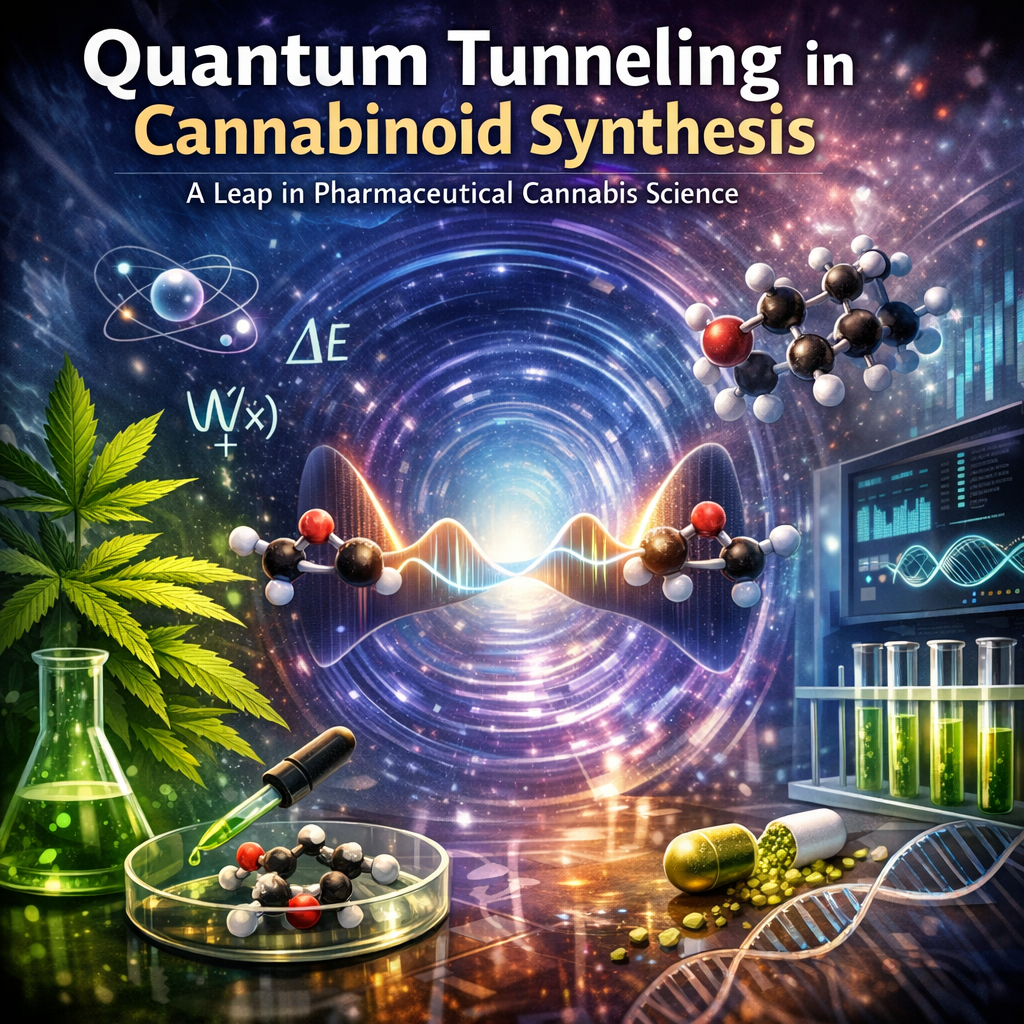
Quantum Tunneling in Cannabinoid Synthesis: A Leap in Pharmaceutical Cannabis Science
The world of cannabis research is continually evolving, and quantum mechanics is offering remarkable insights that could revolutionize our understanding of cannabinoid synthesis. At the forefront of this is the concept of quantum tunneling—a profound quantum phenomenon with significant implications for the synthesis and manipulation of cannabinoids, the active compounds in cannabis. Quantum mechanics, the study of particles at the nanoscale, introduces us to a reality where particles can traverse barriers that classical physics deems insurmountable. In the realm of molecular chemistry, this translates into sophisticated reaction pathways that could enhance and streamline the production of pharmaceuticals.
Cannabinoids, including THC and CBD, possess properties that are highly sought after for medicinal purposes, ranging from pain management to anti-inflammatory effects. Typically, the synthesis of these compounds in laboratories involves complicated processes, often hindered by energy barriers that complicate efficiency and yield. This is where quantum tunneling comes into play, offering a possible transformation in how these processes are approached.
Quantum tunneling allows particles to “tunnel” through energy barriers instead of overcoming them, potentially accelerating chemical reactions and influencing their outcomes. In the context of cannabinoid synthesis, such an approach could significantly reduce the energy required for reactions, diminish production time, and enhance the purity of the final product. This is particularly promising for pharmaceutical applications, where precision and purity are paramount.
Recent advancements in quantum chemistry suggest that leveraging quantum tunneling could optimize the synthetic routes of key cannabinoids. By reducing the need for high temperatures and pressures traditionally used to drive reactions, quantum tunneling provides a pathway toward more sustainable and environmentally-friendly production methods. As the demand for cannabinoid-based therapies grows alongside increasing legalization, these quantum techniques could provide a competitive edge in pharmaceutical chemistry.
Features: Insights from Studies on Quantum Tunneling and Cannabinoid Synthesis
The intersection of quantum chemistry and pharmacology is fast becoming a fertile ground for groundbreaking studies. For instance, a study published in [Nature Chemistry](https://www.nature.com/articles/nchem2382) explored how quantum tunneling can expedite enzyme reactions under physiological conditions. Enzymes, nature’s catalysts, are known to facilitate reactions at ambient temperatures which would otherwise require extreme energy input—specifically relevant for the biosynthesis of cannabinoids like THC and CBD in planta.
In another striking study, researchers investigating the potential of quantum tunneling within synthetic chemistry applications found that certain organic reactions benefited significantly from this phenomenon’s influence, namely, reactions in which tunneling contributed to bond formation across substantial energy barriers. These findings are essential for devising strategies to exploit quantum mechanics in cannabinoid synthesis, leading to potentially more efficient pathways of production at an industrial scale.
Moreover, advanced computational quantum chemistry models, detailed in [PRX Quantum](https://journals.aps.org/prxquantum/abstract/10.1103/PRXQuantum.2.010321), have been used to simulate how quantum tunneling might interact with known cannabinoid biosynthetic pathways. These models suggest various catalytic coefficients could lower activation energies, streamlining reactions crucial to forming active cannabinoid compounds, thereby offering techniques that could be harnessed in pharmaceutical settings for better-controlled synthesis.
Such research emphasizes a paradigm shift in chemical manufacturing for cannabinoids, pointing toward more sustainable, cost-effective production methodologies. This transformation aligns perfectly with the broader goals within the medical cannabis industry, which include improving access, reducing environmental impact, and ensuring consistent product quality.
Conclusion
Quantum tunneling offers an exciting glimpse into the future of cannabinoid synthesis, with the potential to revolutionize pharmaceutical applications of cannabis through more efficient, environmentally friendly processes. As studies continue to unveil the nuances of quantum chemistry within this context, the partnerships between cutting-edge science and practical pharmaceutical applications draw closer. By unlocking the power of quantum tunneling, researchers and professionals can meet the growing demand for high-quality, cannabinoid-based therapies, offering promise and progress in cannabis medicine.
References
1. [Nature Chemistry – Quantum Tunneling in Enzyme Reactions](https://www.nature.com/articles/nchem2382)
2. [Organic Reactions and Quantum Tunneling](https://pubs.acs.org/doi/10.1021/ja053392g)
3. [Computational Simulations in Quantum Chemistry](https://journals.aps.org/prxquantum/abstract/10.1103/PRXQuantum.2.010321)
Concise Summary
Quantum tunneling, the process by which particles traverse barriers they cannot surmount classically, offers potential breakthroughs in cannabinoid synthesis, especially for pharmaceuticals. This quantum phenomenon could enhance production efficiency, reduce energy use, and improve product purity, aligning with goals in the medical cannabis industry. Studies suggest that quantum tunneling can optimize cannabinoid synthetic routes, introducing sustainable methods and competitive advantages. As research progresses, the integration of quantum mechanics into cannabinoid production holds promise for meeting rising pharmaceutical demands effectively.