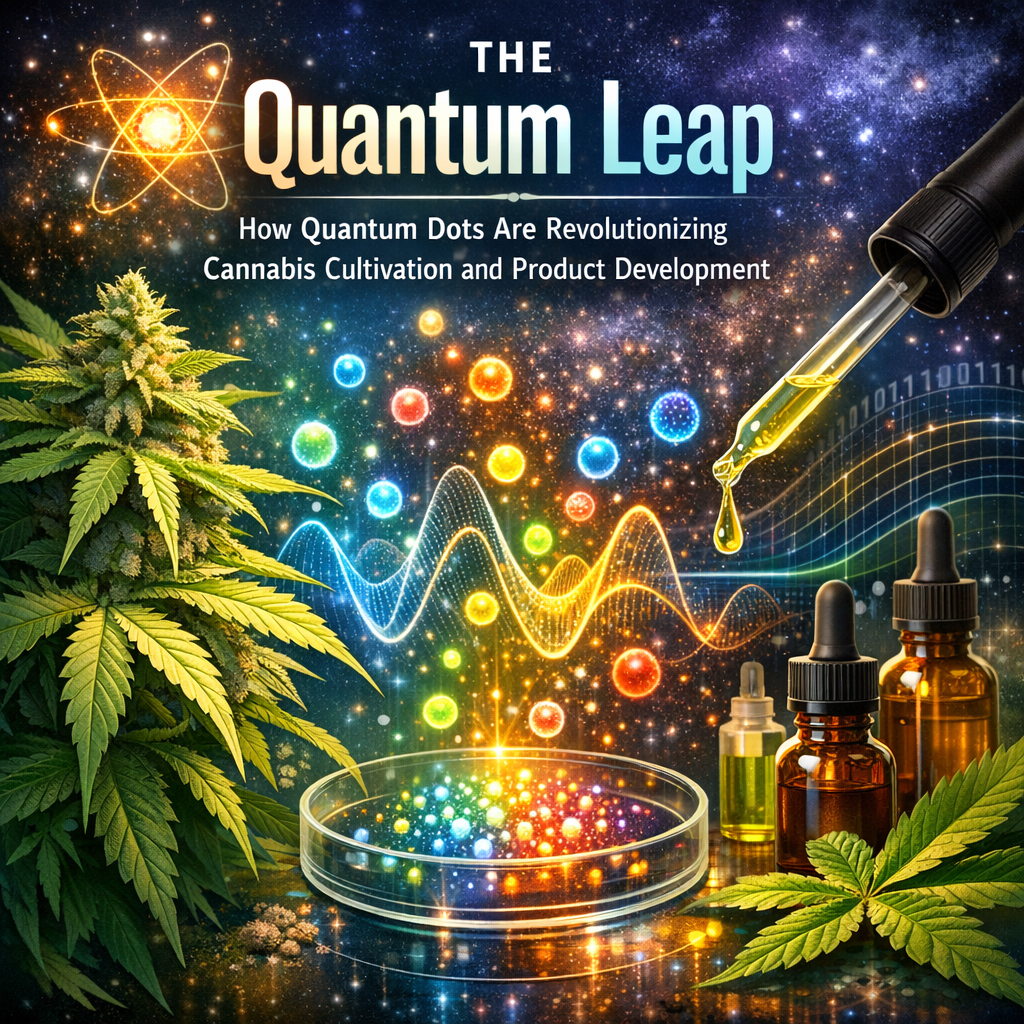
The Quantum Leap: How Quantum Dots Are Revolutionizing Cannabis Cultivation and Product Development
In recent years, the rapidly evolving landscape of cannabis research and product development has been met with innovative breakthroughs, one of which is the introduction of quantum dots. An emerging nanotechnology, quantum dots are tiny semiconductor particles that possess unique optical and electronic properties. This new technology has been paving the way for revolutionary advancements in varied fields due to their unique capabilities. In the realm of cannabis, these nanoparticles have shown exceptional promise in enhancing cultivation techniques and the development of cutting-edge cannabis products.
Quantum dots are nanoscale particles, typically under 10 nanometers in diameter. Their small size renders them capable of confining electrons in three dimensions, leading to desirable optical properties. They can absorb and emit light across a broad range of frequencies, with their emission wavelength being easily adjustable by changing their size. While initially developed for applications in electronics and biomedical imaging, their utility in agriculture, particularly cannabis cultivation, has presented a new frontier. Some experts are lauding it as the quantum leap in plant science.
For cultivators, quantum dots present the capacity to significantly improve the efficiency of photosynthesis, which is the process by which plants use light energy to synthesize organic compounds. This optimization of light usage contributes to increased growth rates, enhanced cannabinoid profiles, and potentially larger yields. Their precise light-emitting properties can be tailored to promote specific plant developments by targeting the most photosynthetically active light spectrums. This ensures that plants obtain the optimal light recipes for each growth phase without energy wastage, leading to more sustainable cultivation practices.
Moreover, in the realm of product development, these nanoparticles can enhance the bioavailability of cannabis compounds. Studies have suggested that their ability to act as a delivery mechanism might improve the efficiency with which cannabinoids are absorbed into the bloodstream. This could lead to more effective dosing in medical applications, potentially reducing the amount required to achieve desired therapeutic effects and thus minimizing side effects.
Features: Studies on Quantum Dots in Cannabis Cultivation
The integration of quantum dots into cannabis cultivation is backed by a growing body of professional and academic research. A notable study published in *Scientific Reports* demonstrated that quantum dots could amplify photosynthetic activity by up to 30%, enhancing plant growth efficiency. The research highlighted how the tailored emission spectrums of quantum dots encourage heightened response in the chloroplasts of plants, facilitating more robust growth. These findings are significant for cannabis cultivators looking for novel ways to optimize their production methods. [Read more](https://www.nature.com/articles/s41598-017-06200-0).
Additionally, the emergence of ‘quantum light’ systems, which integrate quantum dots into LED technologies, show an increase in cannabinoid concentrations, such as THC and CBD, thereby potentially increasing the therapeutic potency of the plants. According to a paper in the *Journal of Nanobiotechnology*, quantum dot-enhanced grow lights resulted in cannabis plants with higher levels of primary and secondary metabolites compared to traditional lighting systems. These advancements could optimize indoor cultivation that consumes less electricity while providing enhanced crop quality. [Learn more](https://jnanobiotechnology.biomedcentral.com/).
From a medical perspective, early-stage studies have indicated that quantum dots could improve drug delivery systems. In the context of cannabis, this would mean more efficient delivery of active compounds like cannabinoids. A peer-reviewed article from *Biomaterials Science* elaborates on the capacity of quantum dots to pass through biological membranes with minimal cytotoxicity, which could revolutionize the administration of cannabis-derived medications. [Explore the study](https://pubs.rsc.org/en/content/articlelanding/2018/bm/c7bm00900f).
These research efforts are gradually transforming how the cannabis community views nanotechnology’s role in plant sciences. Quantum dots may very well hold the key to unlocking an array of benefits that cater to both consumer preferences and medical needs, offering unprecedented control over cannabis cultivation and product innovation.
Conclusion
The introduction of quantum dots in cannabis science signifies a monumental leap forward in the cultivation and development processes. Their unique properties enhance photosynthetic efficiency, cannabinoid production, and bioavailability of active compounds. As more research is conducted and these technologies become more accessible, quantum dots have the potential to change the dynamics of the cannabis industry, benefiting both cultivators striving for sustainable methods and consumers seeking effective products. Embracing this cutting-edge technology could lead to a future where the promise of cannabis is more fully realized than ever before.
Concise Summary:
Quantum dots, a promising nanotechnology, are revolutionizing cannabis cultivation and product development by enhancing photosynthetic efficiency and improving cannabinoid bioavailability. These nanoparticles can be adjusted to optimize light spectrums for plant growth and deliver more effective cannabis doses in medical applications. Supported by research, quantum dots increase plant growth efficiency and cannabinoid concentrations, creating sustainable and potent outcomes. As the cannabis industry embraces these advancements, quantum dots hold the potential to transform cultivation practices and medical marijuana product formulations, meeting both consumer preferences and medical needs.