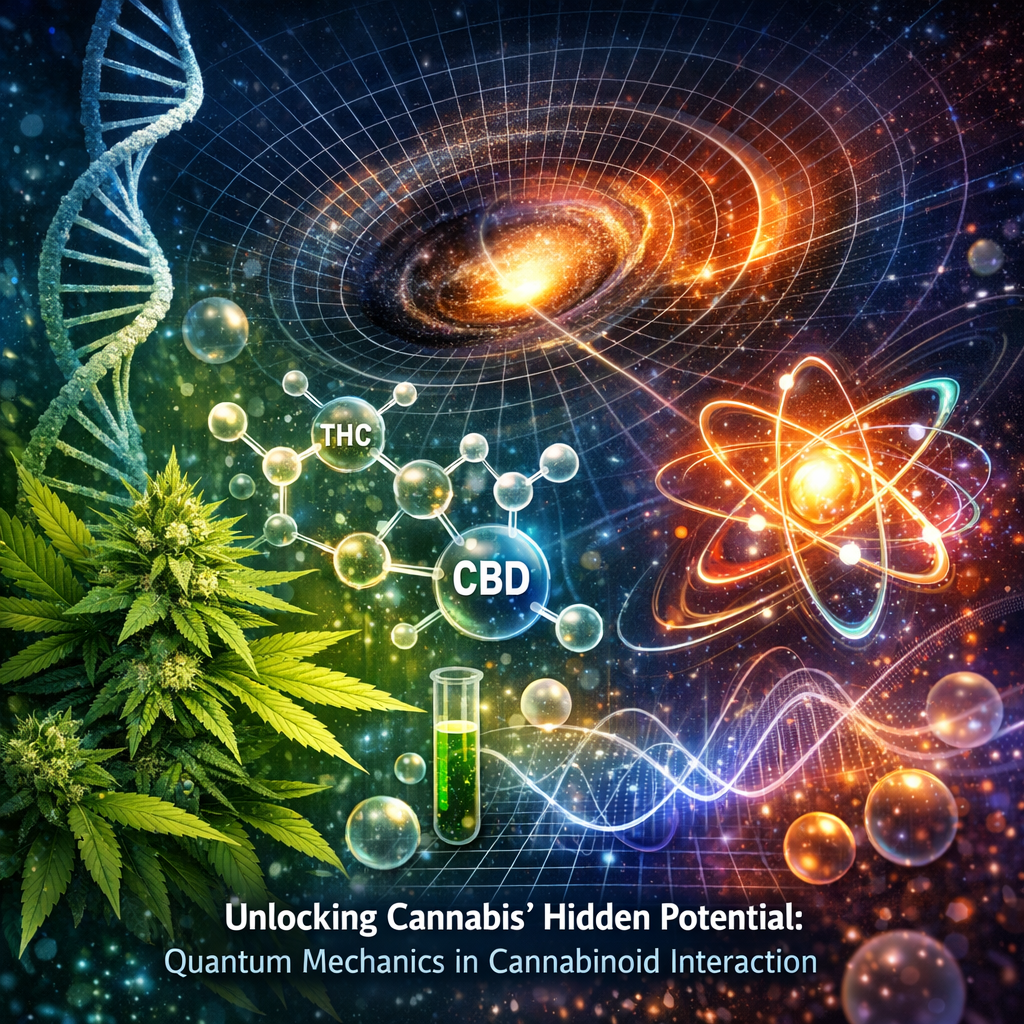
Unlocking Cannabis’ Hidden Potential: Quantum Mechanics in Cannabinoid Interaction
Cannabis has captivated both users and researchers due to its natural complexity and therapeutic potential. Recent advancements in technology have provided new insights into how cannabis affects the human body. An exciting frontier emerges at the intersection of quantum mechanics and cannabinoid interactions. Quantum mechanics, the study of subatomic particles, offers a profound understanding of how cannabinoids might impact mental and physical health on a microscopic scale.
Quantum mechanics, known for explaining phenomena like the duality of light as both particle and wave, broadens our perspective on how molecules like THC (tetrahydrocannabinol) and CBD (cannabidiol) interact with the body’s endocannabinoid system (ECS). The ECS is crucial in balancing processes such as mood, pain sensation, and immune function. Cannabinoids from cannabis bind to CB1 and CB2 receptors, and here quantum mechanics enters: the precise interactions at these sites involve quantum processes like tunneling, where particles pass through energy barriers, and quantum entanglement, which may explain the entourage effect—a phenomenon where combinations of cannabinoids and terpenes produce enhanced effects.
This exploration is not just theoretical—it could redefine how we develop cannabinoid-based therapies, leading to more effective and customized treatments for various conditions. As research progresses, the potential for discovering new therapeutic pathways or enhancing existing ones marks a thrilling chapter in both cannabis research and quantum physics.
Features: Quantum Mechanics Meets Cannabinoid Interaction
Recent studies in quantum biology—a field combining quantum physics and biological processes—explore how cannabinoids like THC and CBD precisely target the ECS. This perspective suggests that cannabinoid-receptor interactions may involve coherence, a quantum property that could enhance signaling efficiency.
A study published in *Nature* examined the possibility of quantum entanglement during cannabinoid-receptor binding. Researchers proposed that entangled states might allow instantaneous communication between cannabinoids and the ECS, influencing how cannabinoids affect brain function or pain perception. [Nature Quantum Cannabinoid Study](https://www.nature.com/subjects/quantum-biology).
Furthermore, examining quantum oscillations and particle wave functions at receptor sites reveals how cannabinoids can fit optimally with receptors, akin to solving a molecular puzzle. This understanding could lead to more precise and effective pharmaceutical derivatives from cannabis.
In medical applications, the concept of quantum superposition—where particles exist in multiple states—could enable cannabinoids as versatile compounds for multiple therapeutic actions. Studies funded by institutions like the Cannabinoid Research Institute investigate these principles to refine cannabinoid efficacy and safety for medical use. [Cannabinoid Research Institute](https://cannabinoidresearch.com/quantum-mechanics).
As research progresses, integrating quantum mechanics with traditional pharmacology could lead to a new generation of cannabinoid medications, improving drug delivery systems, bioavailability, and reducing side effects.
Conclusion:
As science delves into the microscopic world of quantum mechanics, the possibilities for cannabinoids within quantum biology could revolutionize health and wellness approaches. Understanding the quantum interactions of cannabinoids could unlock new therapeutic efficacy levels, transforming cannabis use for medical and recreational purposes. The interplay of these fields heralds an exciting era for cannabis professionals and consumers, enhancing cannabinoid research and treatment development.
Concise Summary: Quantum mechanics offers groundbreaking insights into cannabinoid interactions with the human body. This field of physics explores how particles behave at the subatomic level, providing new understanding of how cannabinoids like THC and CBD interact with the endocannabinoid system. Involving concepts like tunneling and quantum entanglement, these insights could redefine cannabinoid therapy development, leading to more effective and tailored medical treatments. Quantum biology studies suggest the potential for optimizing cannabinoid efficacy and paving the way for the next generation of cannabis-based medications.