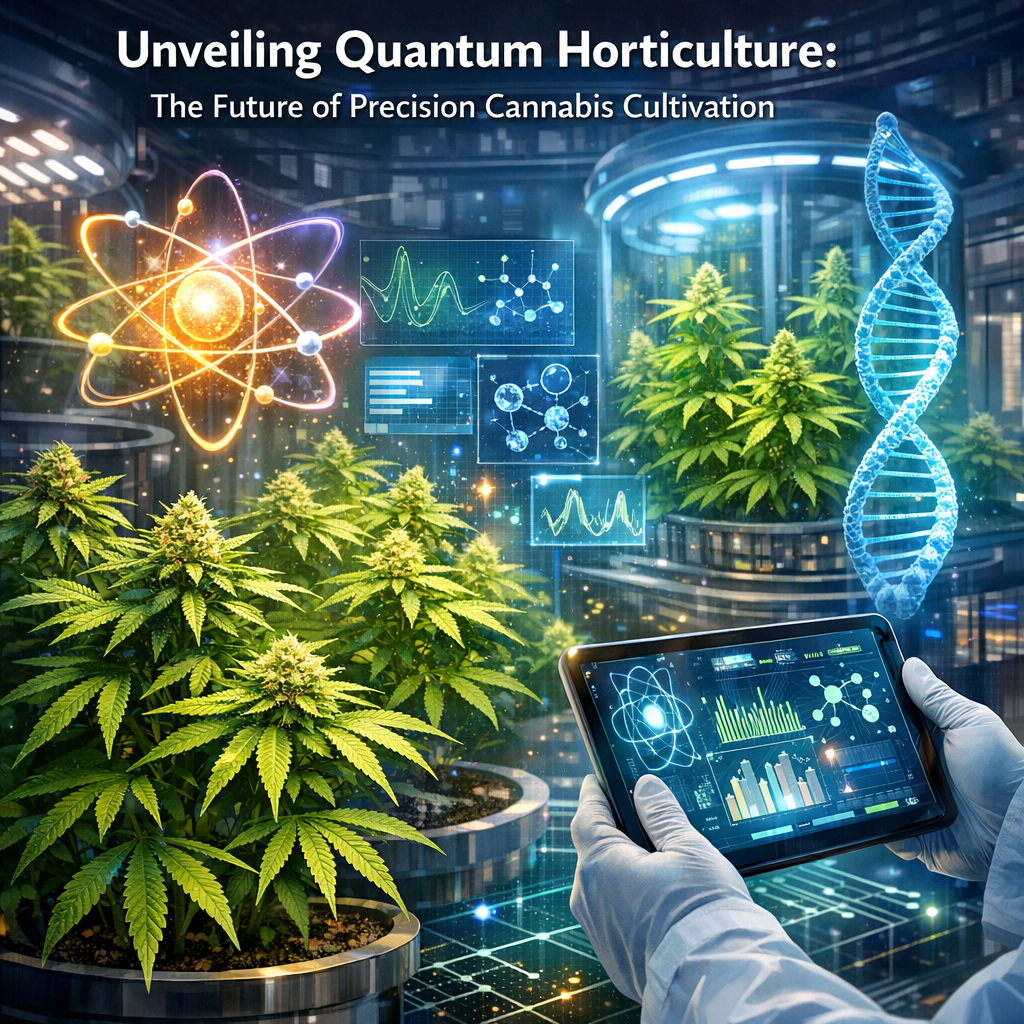
Unveiling Quantum Horticulture: The Future of Precision Cannabis Cultivation
Introduction
As the cannabis industry rapidly expands, so too does the technology used to enhance cultivation efficiency, productivity, and sustainability. Precision cannabis cultivation refers to the application of advanced agricultural practices to optimize the growth and yield of cannabis plants. As we step into a new era of innovation, a concept that seems almost science fiction is making its way into the cannabis arena: quantum horticulture.
Quantum horticulture employs principles from quantum mechanics—an area of physics that explores phenomena at the smallest scales, such as atoms and subatomic particles—to revolutionize plant growing processes. This approach introduces cutting-edge technologies to optimize photosynthesis, nutrient uptake, and plant health with unprecedented precision.
For the cannabis industry, quantum horticulture promises a future where cannabis cultivation is more efficient and tailored to specific strains, resulting in higher yields and improved plant quality. By leveraging quantum entanglement and superposition, growers might be able to control environmental parameters at the quantum level, manipulating variables such as light spectra, gravitational fields, and electromagnetic frequencies to create optimal growth conditions.
Furthermore, quantum computing could offer predictive analytics for cannabis cultivation, managing variables like soil nutrients, water levels, and ambient temperature with unparalleled accuracy. As artificial intelligence and machine learning algorithms are applied to agriculture, growers could maximize resource use, minimize waste, and produce cannabis with richer cannabinoid and terpene profiles.
Moreover, the concept of quantum sensors offers potential breakthroughs in real-time plant monitoring. These sensors could detect minute changes in plant health at the molecular level, providing insights into stress factors beyond current capabilities.
As we stand on the threshold of this transformative journey, quantum horticulture is setting the stage for a future where cannabis cultivation becomes more of an exact science than traditional agriculture alone could allow. This development promises not only enhanced efficiency and yield but also a smarter, more sustainable way to meet the growing demand for cannabis products.
Features
A considerable body of research underpins the potential of quantum horticulture for cannabis cultivation. One promising area is the use of quantum dots—nanocrystals that can manipulate light wavelengths. Studies suggest that quantum dots could be used to optimize the light spectrum in greenhouses, ensuring that plants receive the exact wavelengths necessary for each growth stage. This tailored lighting has demonstrated the potential to accelerate growth rates and enhance the cannabinoid concentration in cannabis plants [source](https://www.sciencedirect.com/science/article/abs/pii/S2772424422000777).
Quantum computing also holds the promise of transforming how data is used in agriculture. By applying quantum algorithms to the complex data sets generated in cultivation, farmers could make real-time decisions to improve efficiency and yield. For instance, maintaining precise environmental conditions is crucial for cannabis plants, which can be stress-sensitive and vary significantly among strains. Quantum computing could analyze thousands of environmental and growth variables in seconds, providing cannabis growers with precise strategies to maximize plant health and productivity [source](https://qz.com/quantum-computing-solve-worst-agriculture-problems-369327).
Additionally, the potential development of quantum sensors offers transformative capacities for monitoring plant health at a microcosmic level. These sensors could theoretically read the quantum state of plants, offering insights into stressors and nutritional needs before they become apparent through traditional observation. This level of early detection could spearhead preventative care and ensure optimal plant vitality throughout the growth cycle, significantly reducing crop loss due to disease or suboptimal conditions [source](https://quantumjournal.org/papers/q-2020-01-31-220/).
Moreover, the use of quantum entanglement and superposition could transform nutrient delivery into a precision science. By understanding how plants process and utilize nutrients on a quantum level, producers could optimize fertilizer formulations to meet the exact needs of each cannabis strain. This approach would not only improve plant health and yield but potentially lead to more complex and potent cannabinoid and terpene profiles, catering to specific consumer demands.
Conclusion
As quantum horticulture begins to make its mark on the cannabis industry, we stand on the brink of a revolution in cultivation methods. By harnessing the precision and insights offered by quantum mechanics, cannabis growers are not only enhancing the productivity and quality of their crops but also fostering sustainability and innovation. As this frontier rich with potential continues to evolve, the future of cannabis cultivation promises to be more scientific, efficient, and profoundly transformative than ever before.
Concise Summary
Quantum horticulture is revolutionizing precision cannabis cultivation by applying quantum mechanics principles to agricultural practices. This approach leverages quantum computing, sensors, and quantum dots to optimize photosynthesis, nutrient uptake, and plant health, resulting in higher yields and improved cannabis quality. The technology offers predictive analytics, allowing real-time management of variables like soil nutrients and ambient temperature. Quantum sensors provide early detection of plant stress, while quantum entanglement refines nutrient delivery. As these advancements continue, quantum horticulture promises a sustainable and innovative future for the cannabis industry.